Soybean harvest is over and it is time to evaluate performance. IP promoters have been active in their quest to sign up growers for next year. Premiums have been established earlier than ever and the story is demand for IP soybeans is high. Please sign up, life is good for IP producers.
I admit to a having a bias because I sell RR soybeans, but the interesting thing is there is a lot of RR soybeans grown in the area for crush and for seed production. I have been doing a straw poll among growers inquiring about yields and a clear trend has emerged. I know that my poll has no scientific basis for accuracy because IP and RR soybeans are never grown by the same grower in the same field. However, this is what I have found out so far.
RR soybeans are yielding better than IP soybeans. Using 50 bus as a bench mark, RR soybeans are consistently above 50. Out of my poll of 20 RR soybean growers, 17 reported yields of over 50 bus. They consistently mentioned a high level of satisfaction with the performance of their RR varieties. Contrast this with the average response of an IP grower. IP varieties have been consistently yielding less than 50 bus and growers express a much higher level of disappointment with these varieties' performance.
If I were to put an average to it I would say the minimum difference is 5 bus. If you take the newest RR genetics like 91Y01, P16T04R and P19T01R the difference is greater than 5 bus.
Assuming 50 bus yield plus a $3 IP premium nets an additional $150 per acre for IP. No doubt this is attractive and worth considering. Taking a 5 bus yield penalty and extra herbicide cost cuts the premium in half. Is $75 dollars worth the extra hassle of making sure the beans are perfect to capture all the premium offered?
I encourage everyone to offer their opinion. If I am wrong, please tell me. I know the discussion will continue.
Friday, October 18, 2013


Tuesday, October 15, 2013
Just When You Thought It Was Safe To Let The Kids Out
A common question the past few weeks has been whether I had seen any ear molds. After the debacle in wheat this past summer and the wet foggy mornings in September, the common assumption was ear mold levels in corn would be high. I have been seeing some low level infection like the picture below for several weeks, but it had remained spotty and not high enough to raise alarm. However, gibberella ear rot is very unpredictable.
.JPG) Three weeks ago this is what it typically looked like. The black tip is a symptom of giberella ear mold development. When you break the cob open it looks you see a rotten core which is a clear illustration of why it is called gibberella ear mold.
Three weeks ago this is what it typically looked like. The black tip is a symptom of giberella ear mold development. When you break the cob open it looks you see a rotten core which is a clear illustration of why it is called gibberella ear mold.
.JPG) I was interested to hear the OMAF summary of their gibberella ear mold survey in corn this past week. The synopsis was ear mold levels are very low, with the exception of a couple of hybrids. I know enough about ear mold to never make too many assumptions and looking around the last few days has made me increasingly nervous. I am seeing more of this white cotton like symptom which most producers identify with ear mold.
I was interested to hear the OMAF summary of their gibberella ear mold survey in corn this past week. The synopsis was ear mold levels are very low, with the exception of a couple of hybrids. I know enough about ear mold to never make too many assumptions and looking around the last few days has made me increasingly nervous. I am seeing more of this white cotton like symptom which most producers identify with ear mold.
.JPG) Another thing I know about ear mold is that visual assessments can be misleading. The presence or absence of visual mold has little bearing on actual toxin accumulation. Mold will continue to grow and produce toxins until corn moisture drops well below 25%. With grain moistures in the 30% range there is still time for toxins to accumulate.
Another thing I know about ear mold is that visual assessments can be misleading. The presence or absence of visual mold has little bearing on actual toxin accumulation. Mold will continue to grow and produce toxins until corn moisture drops well below 25%. With grain moistures in the 30% range there is still time for toxins to accumulate.
I would agree that most fields do not have a mold issue, but corn growers need to pay attention if they see ear molds developing. Moldy corn will always yield less because mold feeds on the starches in the kernel reducing test weights and dry matter..
If you are a livestock producer, harvest and dry the crop as quickly as possible. If you have the flexibility, keep your cleanest fields for feed and sell the rest on the cash market. Blending grain is a tactic that can reduce problems because it is the toxin amount in the finished ration that determines livestock performance.
Going forward Pioneer continues to screen genetics for gibberella mold tolerance. P9754 has been advanced due to outstanding tolerance to ear mold infection.

 Clean grain right to the tip. Priceless.
.JPG)
.JPG)
.JPG)
I would agree that most fields do not have a mold issue, but corn growers need to pay attention if they see ear molds developing. Moldy corn will always yield less because mold feeds on the starches in the kernel reducing test weights and dry matter..
If you are a livestock producer, harvest and dry the crop as quickly as possible. If you have the flexibility, keep your cleanest fields for feed and sell the rest on the cash market. Blending grain is a tactic that can reduce problems because it is the toxin amount in the finished ration that determines livestock performance.
Going forward Pioneer continues to screen genetics for gibberella mold tolerance. P9754 has been advanced due to outstanding tolerance to ear mold infection.


Monday, October 7, 2013
Back in Black
A lot of chatter last week about black layer in corn. It seems everyone is out looking. Some are finding black layer and others have not. Is this a cause for worry?
.JPG) No. This kernel is from a 3000 HU hybrid and is displaying a distinct black layer. Fuller season corn hybrids may not be showing a visual black layer, but they are finished the grain fill process.
No. This kernel is from a 3000 HU hybrid and is displaying a distinct black layer. Fuller season corn hybrids may not be showing a visual black layer, but they are finished the grain fill process.
.JPG) This is a 3100 HU hybrid on the left beside the 3000 HU kernel on the right. There is no moisture left at the base of the later kernel. It just takes a few days for the black layer to visually appear
This is a 3100 HU hybrid on the left beside the 3000 HU kernel on the right. There is no moisture left at the base of the later kernel. It just takes a few days for the black layer to visually appear
.JPG) If you pick the right kernel you can see the early formation of a black layer which some confuse with brown layer. The take home message is this corn crop is complete from a dry matter accumulation point of view.
If you pick the right kernel you can see the early formation of a black layer which some confuse with brown layer. The take home message is this corn crop is complete from a dry matter accumulation point of view.
Grain moisture is a different matter. Healthy corn is anywhere from 28%-35% moisture. Dry down is now a function of heat and humidity. Fifty heat units will take 1 point of moisture out of a kernel that is over 25%. After 25% it takes 75 heat units to drop 1 point of moisture because drier kernels take more heat to remove moisture. With three weeks left in October corn will be 25%-31% by the end of the month. Remember, this is healthy corn. There are already reports of corn at 25% moisture. Corn this dry died a month ago due to northern leaf blight infection and while it may be dry, yield and test weight will be poor.
A customer also asked last week about ordering seed corn with no Cruiser or Poncho insecticide. His field is beside a bee yard and the bee owner has concerns about his bees dying from neonicotinoid poisoning next spring at corn planting time.
The issue of bee mortality is very complicated and even bee keepers do not agree on the causes. However, if the bee owner is concerned with the use of neonic insecticides there are options. Pioneer has committed to providing neonicotinoid free seed for 2014 spring on specific hybrids. The list of hybrids available are popular hybrids over a range of maturity and include the following three which fit our area.


The important point is if you want to keep your bee neighbours happy and enjoy their honey I need to know.
There is a deadline of October 15 for these orders to be processed because the majority of the seed supply will still be treated with neonicotinoid insecticide.
.JPG)
.JPG)
.JPG)
Grain moisture is a different matter. Healthy corn is anywhere from 28%-35% moisture. Dry down is now a function of heat and humidity. Fifty heat units will take 1 point of moisture out of a kernel that is over 25%. After 25% it takes 75 heat units to drop 1 point of moisture because drier kernels take more heat to remove moisture. With three weeks left in October corn will be 25%-31% by the end of the month. Remember, this is healthy corn. There are already reports of corn at 25% moisture. Corn this dry died a month ago due to northern leaf blight infection and while it may be dry, yield and test weight will be poor.
A customer also asked last week about ordering seed corn with no Cruiser or Poncho insecticide. His field is beside a bee yard and the bee owner has concerns about his bees dying from neonicotinoid poisoning next spring at corn planting time.
The issue of bee mortality is very complicated and even bee keepers do not agree on the causes. However, if the bee owner is concerned with the use of neonic insecticides there are options. Pioneer has committed to providing neonicotinoid free seed for 2014 spring on specific hybrids. The list of hybrids available are popular hybrids over a range of maturity and include the following three which fit our area.


The important point is if you want to keep your bee neighbours happy and enjoy their honey I need to know.
There is a deadline of October 15 for these orders to be processed because the majority of the seed supply will still be treated with neonicotinoid insecticide.
Monday, September 23, 2013
Snorkels, Leaf Blight and Sympathy

That was just not called for. Nobody ordered that much water.

Some have been wondering about the bleached look that took over corn fields last week. It looks like the crop was frozen, but not all fields look the same. How come?
The answer is it is not frost. It is Northern Corn Leaf Blight. It starts out looking like this.


Finally a heart felt sympathy is extended to the volunteers of the International Plowing Match after Mother Nature forced them to cancel the last day of the match on Saturday.

Brian took this shot while going in to assist with the evacuation. All the long hours of volunteer effort swamped in a sea of mud. Very sad.
Thursday, September 19, 2013
Harvest 2013
Corn silage harvest cranked up this week. The most common word used so far when describing the corn crop, especially Pioneer 34A85 has been "awesome". The second most common word has been "fantastic".
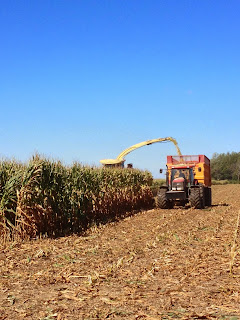 Silage harvesters have been hard to see behind the walls of corn.
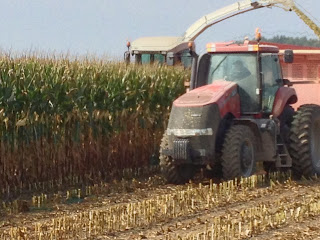
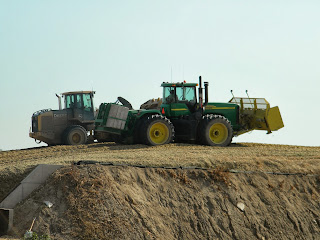 And there is still crop left in the field.
 This is good news for every corn grower. Grain contributes 50% of the weight on average, to silage tonnage. Heavy silage and high grain content go hand in hand. This is evident looking at ear development on full season silage hybrids, like 34A85.
.JPG) Get ready grain producers. Your turn is coming.
Get ready grain producers. Your turn is coming.


Bunkers are overflowing.


.JPG)
Wednesday, September 4, 2013
Firing Squad


For the areas where leaf firing has gone above or is
approaching the ear leaf, or plants show severe stunting, and lighter shades of
green; this has caused concern with growers, and seems to be more excessive in
some areas this year compared to others. In many cases, growers applied N
in such a way to realistically fulfill their yields targets this year, but have
still had excessive firing/N losses.
-
How was the N applied and in what form?
In
many cases this year, side-dressed N fields look strong. Having all N applied
upfront simply puts it more at risk for loss in a year like we had.
The
form of N also played a role. There were growers who side-dressed with Urea,
but didn’t have the moisture to allow it to incorporate into the soil profile,
resulting in N deficiency.
Fertility
programs that credited higher levels of N units to cover crops and manure
didn’t see those units come to fruition in some areas. Mineralization of these
sources of N seemed to be slower this year. In Greg Stewarts pre-side dress
nitrogen sampling survey this year, the level of N available at side-dress time
was lower than expected and is thought to be due to lower levels of
mineralization. (breakdown of organic matter into nitrates).
-
Stresses
Heavy
rains
In
sandy, course-textured soils – the amount of rainfall we had causes large
amounts of N to leach below the root zone and out of reach of plant roots.
In
finer textured soils (clay loams, silt loams) – excessive rainfall caused
saturated soil conditions and denitrification. Denitrification is the process
where soil bacteria breakdown nitrates (the usable form of N) into a non-usable
form for plants, which eventually gets lost to the atmosphere. The key to
denitrification is that the bacteria only breakdown N in anaerobic (saturated)
conditions. Even if there wasn’t necessarily ponding of water in a field,
doesn’t mean those areas weren’t as risk. 5” of rain at a time can make soils
saturated and create anaerobic conditions, even if you don’t see ponding.
Drought
Some
areas became very dry in the last few weeks and some had drought stresses back
around silking. Water is the main carrier of nutrients into a plant. Plants
will sacrifice lower leaves to a greater extent to fill this need. Corn
roots didn’t need to go digging for moisture earlier this spring, and so put
them at a disadvantage when conditions became dry.
Compaction
This
causes root restriction, which doesn’t allow the plants to reach the nutrients,
even if it was available.
-
Yield Losses?
In
cases where whole plant growth was stunted due to excessive moisture,
compaction, drought, etc a yield loss can be expected simply because there is
less plant growth there. 55-60% of a whole plant weight is the grain (harvest
index), and so stunted plants with less above ground growth will yield less.
Yield
losses just from excessive firing are extremely hard to predict. Firing
shows that a plant is prioritizing filling its grain, at the expense of lower
leaves and stalks. One thing to keep in mind would be the late season
standabilty of some of these fields.
Wednesday, August 28, 2013
From Aphids to Agitators
Topic #1
This past week was one of angst for soybean growers. On one hand the soybean market was responding nicely to a weather scare in the US. On the other hand soybean aphid numbers were exploding and eliminating some of those same high priced bushels. By Monday afternoon, Brian and I made the executive decision to stop spraying. If anyone asked, the bean crop was too far advanced and it was becoming revenge spraying. This sort of worked until today when a couple of nervous growers wanted two fields sprayed and Russ wandered across an IMPACT plot where the full season varieties were under heavy pressure and not close enough to the critical R6 stage of development. The R6 stage is when it no longer is worth killing aphids, however a lot of brain cells were being burned last week while trying to determine how close we were to R6 vs aphid numbers. No one was satisfied, which was the reason for the stop work order on Monday. The grower, the agronomist and the custom applicator were all getting grumpy.
The best description of soybean development I have ever seen is courtesy of Shawn Casteel, Purdue Extension. Definitely worth a look and saving for future reference.
http://www.agry.purdue.edu/ext/soybean/Arrivals/10SoyDevt.pdf
Topic #2
I always marvel at how a corn plant can pee on itself. We had 2 mm of rain on Tuesday night which is the first measurable precipitation in 3 weeks.
 The leaves work as a funnel to accumulate that small amount of rain at the base of the plant where it does the most good.
Topic #3
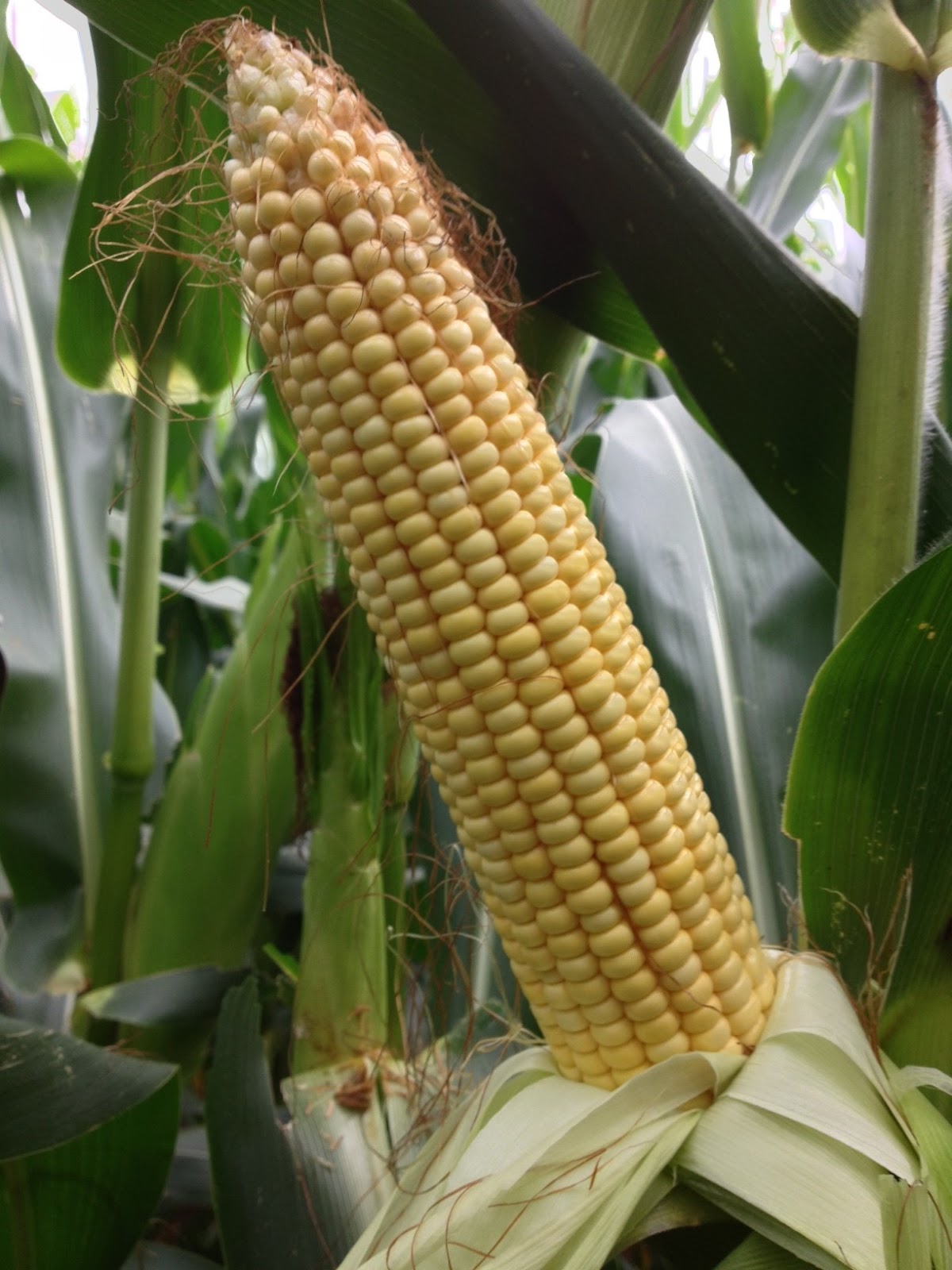
You sometimes hear agronomists preaching tip fill on corn. I took some pictures today in my hybrid test plot.
.JPG) This is P9754YHR a new 97 RM hybrid that has amazing tip fill. This is a heavy test weight, outstanding grain quality hybrid. The plant stand is a solid 33,000 and every tip looked like this one.
This is P9754YHR a new 97 RM hybrid that has amazing tip fill. This is a heavy test weight, outstanding grain quality hybrid. The plant stand is a solid 33,000 and every tip looked like this one.
 This is P9910XR, which will never fill its tip. It can't and won't. Doesn't make it a poor hybrid, just a hybrid that does not fill its tip.
 P0216HR is a hybrid that Pioneer reps south of the 401 think we are crazy to plant this far north. I am not sure I agree with them. Half of the field around the plot is planted to 216. I just need September to be frost free.
 P0094YHR is a new 100 RM hybrid that has my attention. Impressive appearance, with less maturity risk.
Topic #4
Leave it to Nuhn Industries. I attended the North American Manure Expo last week which was held at the University of Guelph Arkell Research Station. On display was Nuhn's latest invention, called the Lagoon Crawler.
 It is an amphibious beast that can drive into a lagoon, maneuver and float while agitating and then drive out of the lagoon when the job is done. The operator controls the unit while standing in complete safety on the bank of the lagoon. Power washer not included.
A more detailed description is at http://www.nuhn.ca/lagoon-crawler.html
This past week was one of angst for soybean growers. On one hand the soybean market was responding nicely to a weather scare in the US. On the other hand soybean aphid numbers were exploding and eliminating some of those same high priced bushels. By Monday afternoon, Brian and I made the executive decision to stop spraying. If anyone asked, the bean crop was too far advanced and it was becoming revenge spraying. This sort of worked until today when a couple of nervous growers wanted two fields sprayed and Russ wandered across an IMPACT plot where the full season varieties were under heavy pressure and not close enough to the critical R6 stage of development. The R6 stage is when it no longer is worth killing aphids, however a lot of brain cells were being burned last week while trying to determine how close we were to R6 vs aphid numbers. No one was satisfied, which was the reason for the stop work order on Monday. The grower, the agronomist and the custom applicator were all getting grumpy.
The best description of soybean development I have ever seen is courtesy of Shawn Casteel, Purdue Extension. Definitely worth a look and saving for future reference.
http://www.agry.purdue.edu/ext/soybean/Arrivals/10SoyDevt.pdf
Topic #2
I always marvel at how a corn plant can pee on itself. We had 2 mm of rain on Tuesday night which is the first measurable precipitation in 3 weeks.

Topic #3
You sometimes hear agronomists preaching tip fill on corn. I took some pictures today in my hybrid test plot.
.JPG)


Topic #4
Leave it to Nuhn Industries. I attended the North American Manure Expo last week which was held at the University of Guelph Arkell Research Station. On display was Nuhn's latest invention, called the Lagoon Crawler.

A more detailed description is at http://www.nuhn.ca/lagoon-crawler.html
Subscribe to:
Posts (Atom)