I have been ignoring this blog for the last few weeks, not because I have been on vacation, but because I was totally engaged in a project that had its beginnings with our home renovation project back in the summer and fall of 2012.
Guests would look out our new patio doors and inquire about our plans for the deck that they assumed would be built. Oh no, Cathy would say, a set of steps leading down to a stone patio would be much nicer than a deck.
Last summer we investigated some options and at one point were leaning to stamped concrete. Our daughter Melissa, cried foul and said oh no, stamped concrete is not the answer. There is a "concrete product" that would be much nicer. As everyone knows, the two words "much nicer" are always followed by the two additional words "more expensive". Nonetheless the special product was ordered. A quote on installation was also received. At that point Cathy declared oh no, that was too much money. We can do it ourselves, love will keep us together. Melissa concurred by telling us she had friends in the business of backyard installations who say the product is dead simple to work with. I know the sales rep and we can also ask him, she claimed. I think you can tell where this story is going.
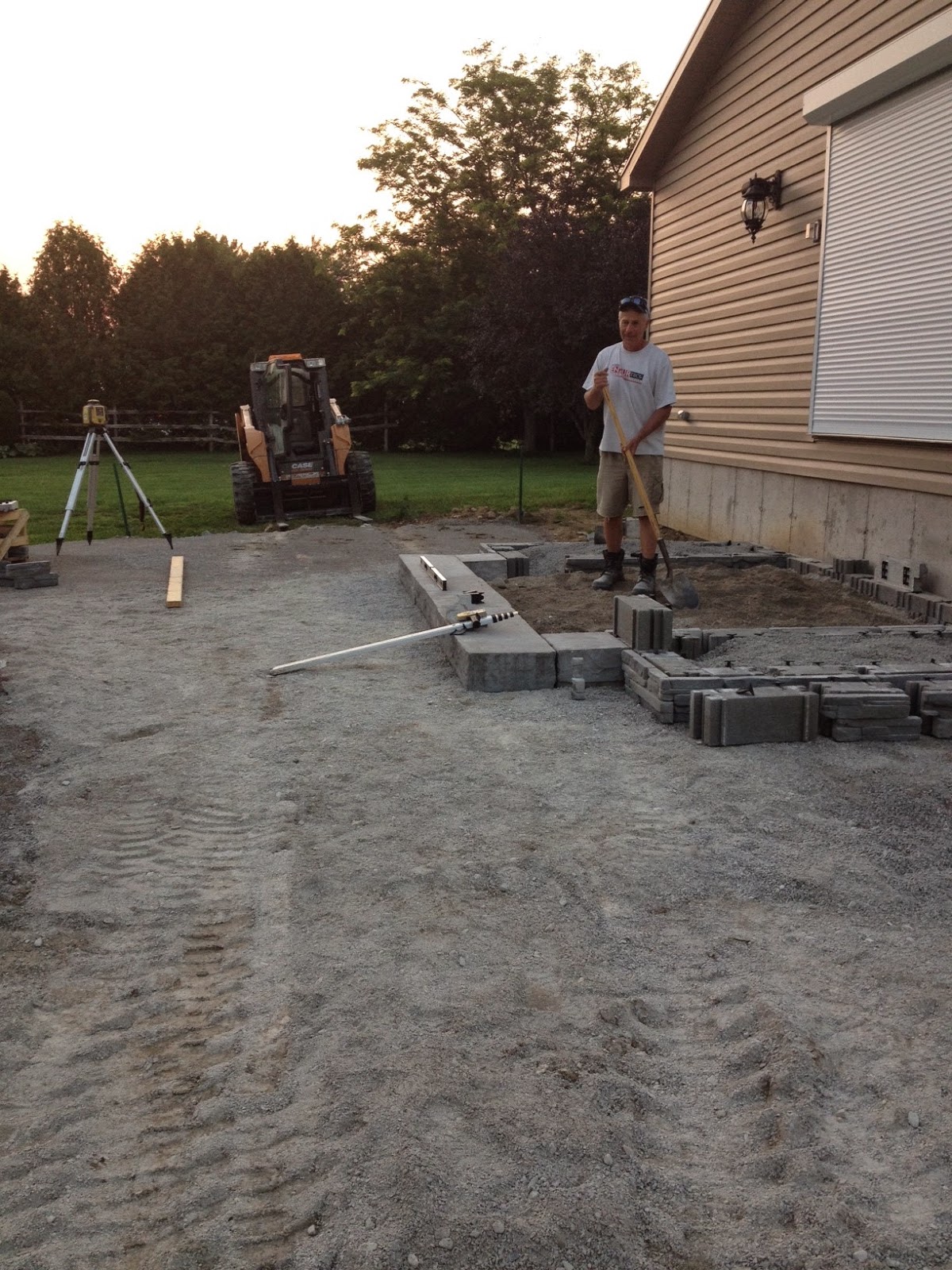
There is a reason why all the home improvement shows on TV use an army to get the real work done while the know-it-all host describes how easy it is to complete the project. The host would die of exhaustion if they actually had to do the work. However, the hardest part is now completed and it will definitely look very nice when fully finished with appropriate flower beds and accessories. No thanks to Melissa who was never around to actually help. But we still love her and will take her advice anytime.
Meanwhile agronomy questions need addressing. The most pressing question has been the topic of fungicide application to corn. Sliding commodity prices are taking the shine off the practice. If you questioned the economics of fungicide with $6.00 corn, current offers at less than $4.00 will make you question it more. I have to agree because if you weigh the average response of 7-8 bushels per acre against the additional cost of $16-35 per acre there is not much room for growth in the bottom line.
Ryan Kennes, a fellow Pioneer rep has written a nice summary of his feelings on fungicide use at the following link.
http://northmiddlesexseed.blogspot.ca/
I particularly agree with his comments on Proline. Livestock producers need to seriously look at this as a means of reducing the risk of gibberella ear mould in corn. Our side by side work with Proline last year produced 10 bushels improvement in yield and 50% reduction in ear mould. We are conducting a Proline trial again this year to increase the data set.
A good discussion about Northern Corn leaf Blight is also available at this link.
http://extension.entm.purdue.edu/pestcrop/2014/issue16/index.html#corn
In the meantime, if you want to help lay some flagstone or dig a water pond come on by.
Monday, July 28, 2014
Monday, July 7, 2014
2014 is Back to Normal
It is early July and the normal questions are coming in.
Why are the soybeans yellow? Why does my corn have tillers?
In these parts of south Perth county, June was much kinder than May. Bill Arthur provides heat unit records to me, which he has been collecting for over 30 years. His temperature data shows that 2014 is a very good example of average with respect to heat. Heat unit accumulation to the end of June is very close to the 30 year average, which for these parts is within an eyelash of 1000 heat units. It is easy to tell this is a typical year because corn is now anywhere from mid-thigh to shoulder and on the fast track to tassel by the end of this month.
Corn planted during the last week of May did not get the full benefit of this heat, but as I have explained before late planted corn makes up the difference by advancing quicker through the vegetative growth stages. The later planted corn is more uniform on average than earlier planted corn which has an additional positive effect on yield for the later planted fields. The 45 mm of rain received in June is half the normal amount, but still more than adequate to sustain early growth. Life is good.
Soybeans are going through a normal yellow stage of growth. This year the condition is a little more pronounced than average, but not a significant cause for alarm. It is a transition period before flowering really starts to commence. The plant is experiencing rapid growth but the nitrogen fixing nodules have not kicked into high gear yet. The yellow fades within a few days.
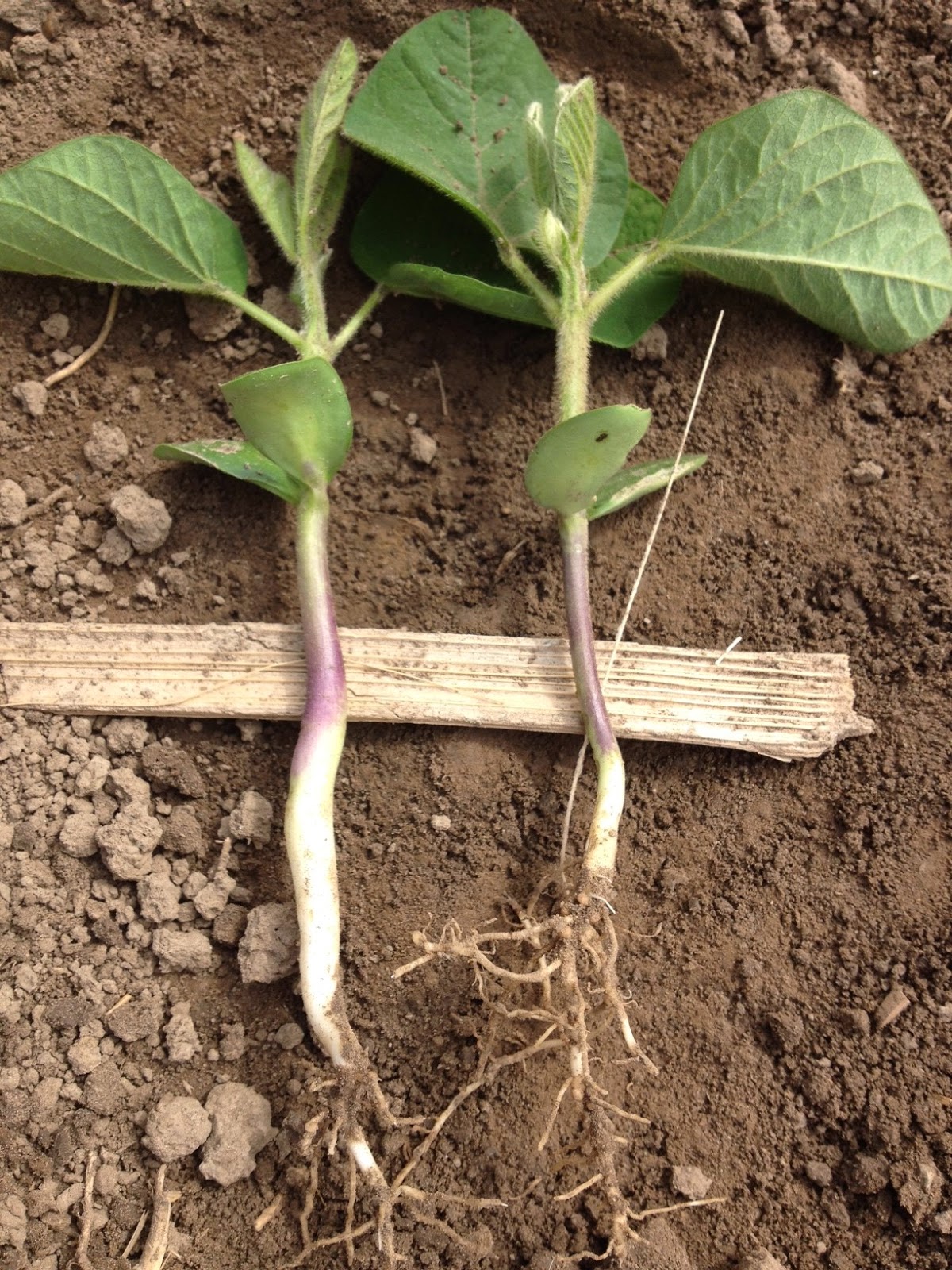
There has been some chatter this week about applying nitrogen to soybeans. I have witnessed before the effects of nitrogen availability on early growth. It can be quite dramatic. This picture is from 2010.
It is the same variety. The yellow plants on the right definitely look distressed. If this was a corn field we would jump all over the yellow corn with side dressed nitrogen to bring it out of its funk. There are some that believe we should be applying nitrogen to soybeans at this stage. It is not a new idea. I played with urea on early flowering soybeans in the 80's and came away frustrated mostly because I was the guy trying to sell the urea. The idea does have merit. It is a standard practice when nodulation failures occur on first year soybeans where there is no native population of nitrogen fixing rhizobia to infect the soybean roots. Commercial nitrogen fixes this problem very efficiently.
However, this is not what caused the yellow beans in the photo.
The field has a history of soybean production. Nodulation was excellent as shown above. There is a rotation difference, with wheat being the previous crop on the left and corn on the right. It looks like the beans on the left would be at least 10% better than the beans on the right. However, at the end of the day the yield difference was negligible. The ugly ducklings still produced 55 bushels.
Another type of yellow was also on display last week. A lot of IP soybeans are grown around here and they had to be resprayed for weed control. The result was lots of scorched soybeans.
It is predominantly surfactant burn as shown by this next picture.
Again, you would think these beans have taken a big hit. I personally hate doing this to soybeans, but the price needs to be paid. The yield loss will be tolerable, if the IP premium is captured . Maybe we should be putting some nitrogen on these plants to help them recover from the shock. Just kidding. Because I am not an IP guy I will let someone else figure that out.
The true challenge of trying to manipulate the soybean plant at this time of year is recovering the dollars spent. Weed control dollars are always a wise choice. Fungicides? Yes, 2-3 bushels is the expected response and that more than covers expenses. Supplemental N? Not a clear cut answer. We need 2-3 bushels to pay for the added expense. My experience trying to boost soybeans with fertilizer in early July has produced more failure than success. I am still open to suggestions.
Corn tillers are also prevalent this time of year. Perfectly normal and usually not a reason for concern.
You will rarely see tillers on a poor field of corn. Corn is a grass, and as such tiller buds are present at the crown. If moisture and fertility are abundant, sunshine hitting the crown will stimulate the tiller buds to grow. This is why tillers are often more prevalent on the edge of the field beside a mowed laneway. Lots of sun on the outside rows will encourage more tillers. They can also be found 30 rows into the field like the plant in the picture above. Tillers are luxury consumers and do not stress the main plant. If the main plant is stressed the tillers will stop growing. During grain fill, the main plant will consume the reserves accumulated in the tiller to help the grain fill process.
The presence of tillers can indicate you could have possibly bumped your plant population by another 2-3000 per acre because the plants are telling you they are not stressed at all. Genetics sometimes come into play because a hybrid can be predisposed to producing more tillers than average, but this is rare.
Why are the soybeans yellow? Why does my corn have tillers?
In these parts of south Perth county, June was much kinder than May. Bill Arthur provides heat unit records to me, which he has been collecting for over 30 years. His temperature data shows that 2014 is a very good example of average with respect to heat. Heat unit accumulation to the end of June is very close to the 30 year average, which for these parts is within an eyelash of 1000 heat units. It is easy to tell this is a typical year because corn is now anywhere from mid-thigh to shoulder and on the fast track to tassel by the end of this month.
Corn planted during the last week of May did not get the full benefit of this heat, but as I have explained before late planted corn makes up the difference by advancing quicker through the vegetative growth stages. The later planted corn is more uniform on average than earlier planted corn which has an additional positive effect on yield for the later planted fields. The 45 mm of rain received in June is half the normal amount, but still more than adequate to sustain early growth. Life is good.
Soybeans are going through a normal yellow stage of growth. This year the condition is a little more pronounced than average, but not a significant cause for alarm. It is a transition period before flowering really starts to commence. The plant is experiencing rapid growth but the nitrogen fixing nodules have not kicked into high gear yet. The yellow fades within a few days.
There has been some chatter this week about applying nitrogen to soybeans. I have witnessed before the effects of nitrogen availability on early growth. It can be quite dramatic. This picture is from 2010.
It is the same variety. The yellow plants on the right definitely look distressed. If this was a corn field we would jump all over the yellow corn with side dressed nitrogen to bring it out of its funk. There are some that believe we should be applying nitrogen to soybeans at this stage. It is not a new idea. I played with urea on early flowering soybeans in the 80's and came away frustrated mostly because I was the guy trying to sell the urea. The idea does have merit. It is a standard practice when nodulation failures occur on first year soybeans where there is no native population of nitrogen fixing rhizobia to infect the soybean roots. Commercial nitrogen fixes this problem very efficiently.
However, this is not what caused the yellow beans in the photo.
The field has a history of soybean production. Nodulation was excellent as shown above. There is a rotation difference, with wheat being the previous crop on the left and corn on the right. It looks like the beans on the left would be at least 10% better than the beans on the right. However, at the end of the day the yield difference was negligible. The ugly ducklings still produced 55 bushels.
Another type of yellow was also on display last week. A lot of IP soybeans are grown around here and they had to be resprayed for weed control. The result was lots of scorched soybeans.
It is predominantly surfactant burn as shown by this next picture.
Again, you would think these beans have taken a big hit. I personally hate doing this to soybeans, but the price needs to be paid. The yield loss will be tolerable, if the IP premium is captured . Maybe we should be putting some nitrogen on these plants to help them recover from the shock. Just kidding. Because I am not an IP guy I will let someone else figure that out.
The true challenge of trying to manipulate the soybean plant at this time of year is recovering the dollars spent. Weed control dollars are always a wise choice. Fungicides? Yes, 2-3 bushels is the expected response and that more than covers expenses. Supplemental N? Not a clear cut answer. We need 2-3 bushels to pay for the added expense. My experience trying to boost soybeans with fertilizer in early July has produced more failure than success. I am still open to suggestions.
Corn tillers are also prevalent this time of year. Perfectly normal and usually not a reason for concern.
You will rarely see tillers on a poor field of corn. Corn is a grass, and as such tiller buds are present at the crown. If moisture and fertility are abundant, sunshine hitting the crown will stimulate the tiller buds to grow. This is why tillers are often more prevalent on the edge of the field beside a mowed laneway. Lots of sun on the outside rows will encourage more tillers. They can also be found 30 rows into the field like the plant in the picture above. Tillers are luxury consumers and do not stress the main plant. If the main plant is stressed the tillers will stop growing. During grain fill, the main plant will consume the reserves accumulated in the tiller to help the grain fill process.
The presence of tillers can indicate you could have possibly bumped your plant population by another 2-3000 per acre because the plants are telling you they are not stressed at all. Genetics sometimes come into play because a hybrid can be predisposed to producing more tillers than average, but this is rare.
Sunday, June 22, 2014
Better Crops? Not!
This is embarrassing. I am supposed to know better. I have a bean field that is a bit of a mess. And I have to look at it every day because it is beside the warehouse.
The recipe started out alright. Harvested corn last fall without causing any ruts, although serious compaction was left where the buggy tracked in and out. Did no fall tillage because soil was too wet. Two trips with an RTS on May 18th to incorporate and distribute some of the heavy trash. Rain later that week kept us from planting. Planted on May 29. Checked seed depth and adjusted to 1-1.5 inches thinking I had adequate moisture at that level. At 2 inches I figured I had gumbo and did not want to go there. That was mistake #1. A combination of 200 bu corn residue from last fall and rapidly drying soil conditions caused me to misjudge the moisture line as the day progressed. Count this as mistake # 2. The resulting variable emergence is a direct result of these two decisions. All because I did not check seed depth and moisture conditions often enough. Attention to detail is a characteristic that separates smart folks from the not so smart. On that particular day count me as one of the not so smart.
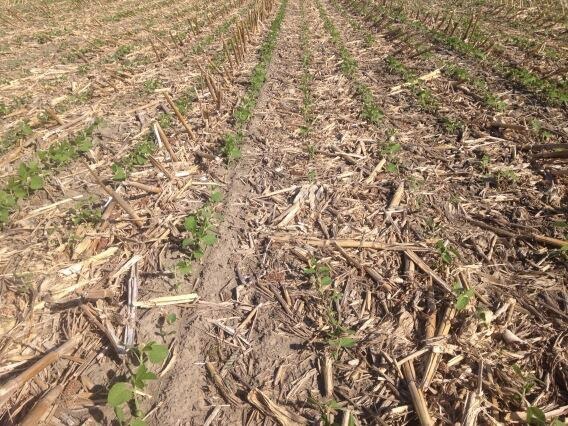
Misery seems to enjoy company. My buddy Paul Sullivan from the Ottawa Valley tweeted a picture of soybean emergence amid heavy corn stalks. It looks a lot like my field.
A survey of other soybean fields in the neighbourhood revealed some similar lack of attention to detail. The owners' identities are being withheld.
The recipe started out alright. Harvested corn last fall without causing any ruts, although serious compaction was left where the buggy tracked in and out. Did no fall tillage because soil was too wet. Two trips with an RTS on May 18th to incorporate and distribute some of the heavy trash. Rain later that week kept us from planting. Planted on May 29. Checked seed depth and adjusted to 1-1.5 inches thinking I had adequate moisture at that level. At 2 inches I figured I had gumbo and did not want to go there. That was mistake #1. A combination of 200 bu corn residue from last fall and rapidly drying soil conditions caused me to misjudge the moisture line as the day progressed. Count this as mistake # 2. The resulting variable emergence is a direct result of these two decisions. All because I did not check seed depth and moisture conditions often enough. Attention to detail is a characteristic that separates smart folks from the not so smart. On that particular day count me as one of the not so smart.
Misery seems to enjoy company. My buddy Paul Sullivan from the Ottawa Valley tweeted a picture of soybean emergence amid heavy corn stalks. It looks a lot like my field.
A survey of other soybean fields in the neighbourhood revealed some similar lack of attention to detail. The owners' identities are being withheld.
Yep, those are beans on top of the ground. And some are still germinating after .5 in of rain last Wednesday.
None of these fields are candidates for replanting, but when the goal is to produce high yielding crops, uniform emergence is a very good starting point.
This field is enlightening. Fall plowing on the left and no- till on the right. Excellent emergence on the left, less than excellent on the right.
Planting depth of beans on the left averaged 2". Those on the right averaged 1" or less. It is not complicated. The deeper planted beans in the conventional tillage were put consistently into moisture. The no-till beans were planted shallower and did not consistently find moisture.
Many farmers have an inherent fear of planting too deep. Usually based on one or two experiences with deep planted crops that did not emerge. There is far less fear of planting shallow. My years of experience have taught me that problems created from planting too shallow out number the problems created from planting too deep by at least 5 to 1. And I still planted too shallow. That is the definition of dumb.
The best beans this spring are those planted into conventionally tilled ground. It seems that at this point there was no such thing as too much tillage.
But the secret is not tillage. It is placing seed uniformly well into the moisture line. Even when that line is two inches.
Coming back to my field by the warehouse. The story is far from over. The worst spots are close to the road. The majority of the field is very acceptable. As Horst Bohner says, the month of August makes beans. Differences in June do not always mean much in the soil types of Perth county. That is the unique thing about soybeans. They do not punish us for our spring mistakes like other crops do. Part of the reason why bean acres outnumber corn acres.
Tuesday, June 10, 2014
Not Exactly The Royal York
Luxury hotels provide king size beds, soft towels, fluffy pillows, stocked refrigerators, massage therapy and other items to ensure their guests speak highly of the facilities and service offered.
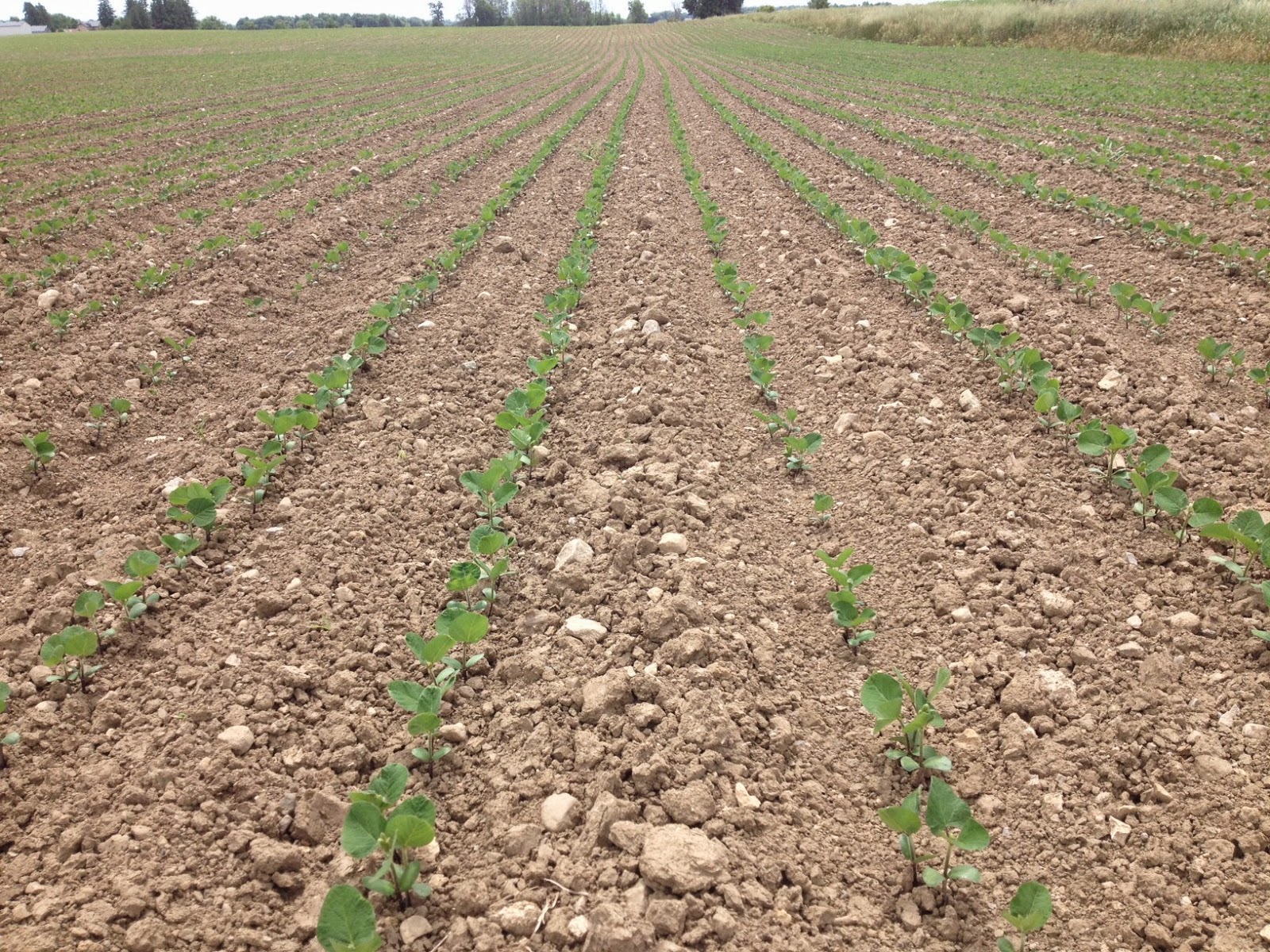
Contrast this with the seedbed accommodations we provided this spring to our corn and soybean seed. If the seed planted could post on line reviews of our efforts, the comment section would be filled with multiple expletives***!!!!***. None of them would be complementary from what I have seen, including my own efforts. A sampling of seed bed shots taken over the past few weeks are posted below.
Lots of lumps, bumps and rough rides across many fields. The good news is if you bedded your corn during the last week in May and put it into moisture, the guests have grudgingly paid their bill by emerging in a normal fashion.
The bad news is if you were unlucky to put your guests to bed on May 18 and 19 many of them never had a chance to emerge.
Heavy rains on the 20th through the 22nd turned the beds into death traps. Stands are reduced in these fields by 20-30% on average. Certainly serious but not bad enough to justify re-plant.
Most of the victims suffered from the "leafing out underground" affliction as shown below.
Leafing out is the result of the coleoptile rupturing before it emerges in the upright position. The coleoptile is the protective sheath that covers the emerging leaf shoot. Most people can relate to the needle stage of growth when the corn shoot is at, or just below the soil surface. What they are seeing is the protective coleoptile which under normal circumstances will only open when it senses light upon breaking the soil surface, allowing the leaf shoot to emerge.
In this picture you can actually see the leaf tissue inside the coleoptile sheath. The swollen and crumpled mesocotyl which brings the coleoptile to the surface indicates how tough it was for the seedling trying to find a way to emerge. Unfortunately when under this much stress the coleoptile will rupture prematurely. Usually a small amount of light penetrating around a crack will cause the coleoptile to open and the new leaf will have no where to go.
Another example of a leaf emerging out of what appeared to be a worm hole on the side of a hard consolidated lump of soil.
As these and other fields develop further we will see more effects of poor seedbeds as new roots try to establish in an environment of smeared sidewalls and tight hard pans just under the seedbeds.
Please do not interpret this as me being critical of anyone's efforts because we all did our best when faced with difficult soil conditions. My friends that farm the farm the heavy flat clay soils of Lambton or Niagara have no sympathy for us spoiled brats either.
A rain dance is required to reduce the effects of the seedbed mess. It will take at least normal amounts of rain spread over the next 4 weeks to salvage all our 4 star ratings as good hosts to our seed guests.
Contrast this with the seedbed accommodations we provided this spring to our corn and soybean seed. If the seed planted could post on line reviews of our efforts, the comment section would be filled with multiple expletives***!!!!***. None of them would be complementary from what I have seen, including my own efforts. A sampling of seed bed shots taken over the past few weeks are posted below.
Lots of lumps, bumps and rough rides across many fields. The good news is if you bedded your corn during the last week in May and put it into moisture, the guests have grudgingly paid their bill by emerging in a normal fashion.
The bad news is if you were unlucky to put your guests to bed on May 18 and 19 many of them never had a chance to emerge.
Heavy rains on the 20th through the 22nd turned the beds into death traps. Stands are reduced in these fields by 20-30% on average. Certainly serious but not bad enough to justify re-plant.
Most of the victims suffered from the "leafing out underground" affliction as shown below.
Leafing out is the result of the coleoptile rupturing before it emerges in the upright position. The coleoptile is the protective sheath that covers the emerging leaf shoot. Most people can relate to the needle stage of growth when the corn shoot is at, or just below the soil surface. What they are seeing is the protective coleoptile which under normal circumstances will only open when it senses light upon breaking the soil surface, allowing the leaf shoot to emerge.
As these and other fields develop further we will see more effects of poor seedbeds as new roots try to establish in an environment of smeared sidewalls and tight hard pans just under the seedbeds.
Please do not interpret this as me being critical of anyone's efforts because we all did our best when faced with difficult soil conditions. My friends that farm the farm the heavy flat clay soils of Lambton or Niagara have no sympathy for us spoiled brats either.
A rain dance is required to reduce the effects of the seedbed mess. It will take at least normal amounts of rain spread over the next 4 weeks to salvage all our 4 star ratings as good hosts to our seed guests.
Friday, May 23, 2014
Looking For A Good Witch Doctor
Weather forecasters get little respect and at times deservedly so. One frustrated customer earlier today made the comment after another 48 hours of cold and drizzle, that was previously forecasted as warm and sunny, that he would love to have a job where you could be constantly wrong and still get paid. I know many of you would agree with that sentiment. Forecasting weather in these parts is a fool's pastime.
Rather than get all depressed about the work that still needs to be done with June 1 looming a week away and worry over the potential pitfalls of wet soils, poor seedbeds,weed escapes, fertility and insect alerts I believe it is time to keep the mood light. I have been reading a book entitled Under A Flaming Sky by Daniel James Brown. It is the true story of a firestorm that destroyed the town of Hinckley Minnesota in 1894.
This story itself is not one that would lighten your mood, but the description of weather forecasting in the 1890's seems appropriate to share in this space. According to the author during the last decades of the 19th century meteorology was very much in its infancy as a science and practitioners were often ridiculed as alchemists and witch doctors. The National Weather Service was created in late 1870 and initially did no more than publish maps of past weather. Early forecasts were based on proverbs and folklore.
1. A red sun has water in its eye. (I was taught that red sky at night was a sailors delight)
2.When the walls are unusually damp, expect rain. (This makes good sense)
3. Hark! I hear the asses bray. We shall have some rain today. (Never owned an ass, so no comment)
4. The further the sight, the nearer the rain. (I have no idea what this means)
5. Clear moon, frost soon. (Yep that can happen)
6. When deer are in grey coat in October, expect a severe winter. (I don't recall seeing grey deer last fall)
7. Anvil shaped clouds are likely to be followed by a gale of wind. (And a chance of hail!!)
8. If rain falls during an east wind, it will continue for a full day. (Sometimes)
9. A yellow sky at sunset presages wind. A pale yellow sky at sunset presages rain. (How do you tell the difference between a yellow and a pale yellow sky?)
10. Much noise made by rats and nice indicate rain. (My personal favourite)
Eveyone raised on a farm before the internet age can rhyme off many other proverbs rural folk used to predict the weather.
My prediction is planting weather is coming. Work safe. In the meantime, has anyone ever met an unemployed weather forecaster?
Rather than get all depressed about the work that still needs to be done with June 1 looming a week away and worry over the potential pitfalls of wet soils, poor seedbeds,weed escapes, fertility and insect alerts I believe it is time to keep the mood light. I have been reading a book entitled Under A Flaming Sky by Daniel James Brown. It is the true story of a firestorm that destroyed the town of Hinckley Minnesota in 1894.
This story itself is not one that would lighten your mood, but the description of weather forecasting in the 1890's seems appropriate to share in this space. According to the author during the last decades of the 19th century meteorology was very much in its infancy as a science and practitioners were often ridiculed as alchemists and witch doctors. The National Weather Service was created in late 1870 and initially did no more than publish maps of past weather. Early forecasts were based on proverbs and folklore.
1. A red sun has water in its eye. (I was taught that red sky at night was a sailors delight)
2.When the walls are unusually damp, expect rain. (This makes good sense)
3. Hark! I hear the asses bray. We shall have some rain today. (Never owned an ass, so no comment)
4. The further the sight, the nearer the rain. (I have no idea what this means)
5. Clear moon, frost soon. (Yep that can happen)
6. When deer are in grey coat in October, expect a severe winter. (I don't recall seeing grey deer last fall)
7. Anvil shaped clouds are likely to be followed by a gale of wind. (And a chance of hail!!)
8. If rain falls during an east wind, it will continue for a full day. (Sometimes)
9. A yellow sky at sunset presages wind. A pale yellow sky at sunset presages rain. (How do you tell the difference between a yellow and a pale yellow sky?)
10. Much noise made by rats and nice indicate rain. (My personal favourite)
Eveyone raised on a farm before the internet age can rhyme off many other proverbs rural folk used to predict the weather.
My prediction is planting weather is coming. Work safe. In the meantime, has anyone ever met an unemployed weather forecaster?
Thursday, May 15, 2014
Well Oliver, Now What Do We Do?
Cathy sometimes says this to me when things do not go according to plan. The 2014 planting season is an example of a plan not going as anticipated.
The crop input industry obsesses over percent planting progress. How much corn is planted is the question often asked with breathless anticipation, as if the whole world turns on the answer. To those of us that have to plant the stuff, the answer to this question in my opinion falls into the gossip category. Nice to know, but not very meaningful. I would not base any conclusions on the relative planting progress of any crop.
Locally, a few of my customers are done planting corn. Many others have barely started or not started at all. The decisions that each have to make going forward are totally different based on their individual situation.
The purpose of this post is to focus on the unplanted corn acres. Seed is sitting in the shed and the foremost question now is whether to switch that full season corn for an earlier hybrid. Fear of the unknown is a powerful force. In this case it is fear of the upcoming growing season. What can happen that will make it worse? Knowledge and wisdom help to mitigate the fear.
The generally accepted wisdom for the 28-3000 heat unit area we operate in is that you should not switch adapted maturities until May 25, and then only drop by 100 HU. I tend to support this recommendation, but it is always good to challenge your own assumptions.
To look at this recommendation another way I pulled the data from the 2011 Ontario Corn Committee trial planted at Exeter on June 6.
This location's 5 year HU average rating is 3052 HU. The trial was planted on June 6 in 2011, accumulating 2739 HU through to maturity and harvested on November 3. If the plot had been planted on May 1 the HU accumulation in 2011 would have been 3334. The June 6 planted corn missed 595 HU thanks to the late planting date caused by wet field conditions.
For the purpose of this analysis I broke the plot into 4 maturity groups.
Group 1 2700 - 2900 HU (15 hybrids)
Group 2 2900 - 3000 HU (23 hybrids)
Group 3 3000 - 3050 HU (20 hybrids)
Group 4 3050 - 3150 HU (20 hybrids)
If I asked 100 agronomists which group was the highest yielding and most economical to plant on June 6, what would you expect them to predict? What would you predict yourself?
On face value one would think that earlier hybrids would have an advantage if there was only 2739 HU available for crop development.
Here are the results from 2011.
Group 1 172.0 bu @ 27.6%
Group 2 179.7 bu @ 29.1%
Group 3 191.9 bu @ 31.6%
Group 4 198.0 bu @ 33.7%
Would you trade an extra 26 bu /acre for 6.1 points of extra moisture? My math tells me that is worth an extra $91 per acre (26 x $4.50 per bushel, less additional drying cost calculated at 198 bu x 13 cents).
If we took this data completely to heart we should be trading in our 3000 HU hybrids for 3100 HU, but that would be foolish. Most of us can't stand harvesting and drying 34 % corn for very long, so let's agree to toss out group 4.
Group 3 delivered an extra 19.9 bu for 4 points of extra moisture, which adds up to an extra $73 per acre over Group 1.
How can this happen? Why would 3000 HU hybrids reach maturity AND carry extra yield with only 2739 HU to work with? This has to be a fluke.
It is not a fluke. Pioneer has looked at this many times trying to help growers make the best decisions when facing less than perfect planting date conditions. They have planted hybrids on May 1, then planted the same hybrids on May 31 and compared the development of each planting date through silking to final maturity. What the data proves is corn hybrids adjust for late planting dates. They adjust by speeding up the vegetative growth stage and start to tassel quicker than you would expect them to based on heat accumulation. The heat missed in May has a very small effect on their development. I use the soybean plant as an analogy when explaining this concept. Soybeans are day length sensitive, which means shorter the shortening sunshine hours in July trigger flowering. The corn plant appears to behave the same way when planted late.
To complicate matters my horticulturalist expert Cathy, keeps telling me that her flowers and fruit trees are two weeks behind normal.
This is a picture of our apple trees with no sign of blossom. Normally they blossom around the end of April. Is there that much more season to come? Don't know for sure, never will. However I am willing to bet a full summer still lays ahead.
Nature is truly fascinating.
The crop input industry obsesses over percent planting progress. How much corn is planted is the question often asked with breathless anticipation, as if the whole world turns on the answer. To those of us that have to plant the stuff, the answer to this question in my opinion falls into the gossip category. Nice to know, but not very meaningful. I would not base any conclusions on the relative planting progress of any crop.
Locally, a few of my customers are done planting corn. Many others have barely started or not started at all. The decisions that each have to make going forward are totally different based on their individual situation.
The purpose of this post is to focus on the unplanted corn acres. Seed is sitting in the shed and the foremost question now is whether to switch that full season corn for an earlier hybrid. Fear of the unknown is a powerful force. In this case it is fear of the upcoming growing season. What can happen that will make it worse? Knowledge and wisdom help to mitigate the fear.
The generally accepted wisdom for the 28-3000 heat unit area we operate in is that you should not switch adapted maturities until May 25, and then only drop by 100 HU. I tend to support this recommendation, but it is always good to challenge your own assumptions.
To look at this recommendation another way I pulled the data from the 2011 Ontario Corn Committee trial planted at Exeter on June 6.
This location's 5 year HU average rating is 3052 HU. The trial was planted on June 6 in 2011, accumulating 2739 HU through to maturity and harvested on November 3. If the plot had been planted on May 1 the HU accumulation in 2011 would have been 3334. The June 6 planted corn missed 595 HU thanks to the late planting date caused by wet field conditions.
For the purpose of this analysis I broke the plot into 4 maturity groups.
Group 1 2700 - 2900 HU (15 hybrids)
Group 2 2900 - 3000 HU (23 hybrids)
Group 3 3000 - 3050 HU (20 hybrids)
Group 4 3050 - 3150 HU (20 hybrids)
If I asked 100 agronomists which group was the highest yielding and most economical to plant on June 6, what would you expect them to predict? What would you predict yourself?
On face value one would think that earlier hybrids would have an advantage if there was only 2739 HU available for crop development.
Here are the results from 2011.
Group 1 172.0 bu @ 27.6%
Group 2 179.7 bu @ 29.1%
Group 3 191.9 bu @ 31.6%
Group 4 198.0 bu @ 33.7%
Would you trade an extra 26 bu /acre for 6.1 points of extra moisture? My math tells me that is worth an extra $91 per acre (26 x $4.50 per bushel, less additional drying cost calculated at 198 bu x 13 cents).
If we took this data completely to heart we should be trading in our 3000 HU hybrids for 3100 HU, but that would be foolish. Most of us can't stand harvesting and drying 34 % corn for very long, so let's agree to toss out group 4.
Group 3 delivered an extra 19.9 bu for 4 points of extra moisture, which adds up to an extra $73 per acre over Group 1.
How can this happen? Why would 3000 HU hybrids reach maturity AND carry extra yield with only 2739 HU to work with? This has to be a fluke.
It is not a fluke. Pioneer has looked at this many times trying to help growers make the best decisions when facing less than perfect planting date conditions. They have planted hybrids on May 1, then planted the same hybrids on May 31 and compared the development of each planting date through silking to final maturity. What the data proves is corn hybrids adjust for late planting dates. They adjust by speeding up the vegetative growth stage and start to tassel quicker than you would expect them to based on heat accumulation. The heat missed in May has a very small effect on their development. I use the soybean plant as an analogy when explaining this concept. Soybeans are day length sensitive, which means shorter the shortening sunshine hours in July trigger flowering. The corn plant appears to behave the same way when planted late.
To complicate matters my horticulturalist expert Cathy, keeps telling me that her flowers and fruit trees are two weeks behind normal.
This is a picture of our apple trees with no sign of blossom. Normally they blossom around the end of April. Is there that much more season to come? Don't know for sure, never will. However I am willing to bet a full summer still lays ahead.
Nature is truly fascinating.
Tuesday, April 29, 2014
A Swing and A Miss
Baseball season is back, the Jays are following the Leafs and I just struck chasing a high hard one. Back in February I posted how comfy the wheat crop would be under that big blanket of snow. Boy was I wrong. I have been fielding some questions about why I haven't made any comments about the poor state of the wheat crop on this blog. That is because I was waiting for the wheat crop to tell us more. I knew it was bad, but how bad? Windshield assessments can be extremely misleading. It is only when we get out and walk looking for new growth that we begin to get a feel for the crop's condition. Monday night, Brian got off the sprayer and quickly announced that half the wheat fields he just finished putting nitrogen on should be tore up. His exact words contained the word junk if my memory is accurate. He is young and prone to over reacting, but his assessment is pretty close to the truth.
What happened?
A month after my post in February, Rick DeBrabandere showed me some pictures from a ski trip across his wheat field during the 3rd week of March.
The dark areas in the middle are ice. Under the snow there was more ice.
A lot of ice.
An easy 6-8 inches of solid ice right on the bottom under the snow pack. Cannot remember seeing that before. There had been no thaw. This farm is not heavy land and it drains reasonably well. It is hard to describe the combination of events that lead to the ice buildup. It seems like the snow was melting slowly during the day, but before the water could get away, it was accumulating as ice under the snow cover. The thick layer of ice smothered the crop out. End of story.
Making the decision to take out a wheat crop is not easy. Most agronomists would advise against it because the future is so hard to predict. There is some comfort in the devil that you know vs the unknown. Some questions to ask yourself.
What is the rotation history on this farm?
What about future rotations? There is still a rotation benefit to keeping the wheat.
Do you have soybean cyst nematode?
What is your crop insurance yield guarantee?
Do you need straw?
Will you need a place to spread manure in August?
Was the plan to put in a cover crop after wheat to improve soil structure or provide additional feed?
If the plan is to keep a damaged field what can you do to make the most out of a tough situation?
- Treat it like a wheat crop. Don't give up. Put on a full rate of N and maybe a little more, control weeds, apply fungicides, do everything you can to make the good areas yield well. The crop still has to be managed and will respond to inputs.
- If you can work with the feed grain, plant barley in the thin spots and combine separately.
- Spread single cut clover to establish in the weak areas and help keep weeds in check.
- Come back with cover crops to improve soil structure.
If the decision is made to start over what is the best strategy?
- Spray glyphosate sooner than later. Two reasons. It makes the decision permanent and you want the wheat dead before the planter goes across the field. Wheat is hard to kill with tillage. If you disturb it and then spray it is also harder to kill. Where the wheat stand is healthy the soil will stay wet and gummy because of the sugars and resins that exude from the roots. This makes for variable seedbed conditions. Kill the wheat and let the roots start to decay as soon as possible. Even half a day can make a difference.
- If you choose to plant soybeans there is a 10% yield loss to 2nd year soybeans. If SCN is around the yield penalty could be higher.
- You should be able to no-till corn or beans without tillage. At the most one shallow tillage pass is enough for a seed bed.
- If corn is planted, account for the N already applied to the wheat.
- If soybeans are planted don't worry about nitrogen causing problems. The soybeans won't care, nodulation will still occur, the crop will survive and do well. An exception to this would be a field with a long history of white mold infection.
It has been said that a poor wheat crop will cause a headache in the spring. The headache will disappear in June when the crop looks much better, but the headache will return at harvest. The 2014 wheat crop will definitely be a source of headaches.
Subscribe to:
Posts (Atom)

.jpg)
.jpg)
.jpg)