Tuesday, September 16, 2014

The Circle of Life

One advantage of experience, or some would say old age, is the perspective it provides.  When I was a baby in the world of agronomy, the accepted rule of thumb regarding hybrid selection for corn silage was the best grain corn hybrid was also the best silage hybrid.  Maximizing grain yields and the subsequent energy in that grain seemed logical to me, even though my only direct experience came from feeding corn silage to beef cattle.  
Dairy customers complained about this recommendation, citing whole kernels present in the manure and having to sweep loony sized cob pieces out of the feed bunk.  These were valid criticisms.  I have vivid memories from 20 years ago of a respected dairyman taking me to the woodshed about Pioneer's lack of commitment to corn silage breeding. Francis Glenn with his development of leafy corn silage genetics turned the silage market upside down and gave dairy customers what they wanted.  Specifically, high feed intakes, clean feed bunks and fully digested kernels.  The cold world of economics was not as kind to the leafy silage producer because leafy hybrids provided no flexibility, took more silage acres to feed his/her herd and required more storage to make it from one season to the next.  
Self propelled harvesters with kernel processors, plus the adoption of TMR feed mixers, eliminated the problems associated with grain corn hybrids being used as silage hybrids.  Mature corn kernels and cob chunks were smashed into tiny pieces that could not be separated by fussy four legged dairy cows.  Silage acres have swung back to conventional dual purpose type hybrids.  Tim Emerson  a respected independent dairy nutritionist, told me a year ago that if he had his way, the perfect silage hybrid would simply be a great big cob on a short stick.  After 30 years of evaluating corn hybrids for silage I was back to where I started.  
Despite this back to the future type experience, there is a lot we have learned about corn silage in the last 30 years.  One important point is the role of environment with respect to fibre digestibility.  With the exception of brown mid-rib hybrids, only 3% of the variation in fibre digestibility can be attributed to genetics.  97% of the variation is due to weather.  We know that warm, hot years like 2012 increase fibre digestibility.  Cool slow growing seasons like 2014 depress fibre digestibility.  It will be normal for corn silage this winter to not have the punch that it otherwise might have.  
The next chart appears complicated, but the message is simple.  Waiting to harvest corn silage until whole plant moisture is in the 60-65% range increases starch levels and maintains fibre digestibility
A standard rule of thumb for silage timing has been to target the period of 45 days after silking to begin harvest. Another measure is 1/3 – 1/2 milk line descent from top of kernel.  While these recommendations get us into the corn silage window, they tend to target 70% whole plant moisture.  If harvest does not happen until 55-60 days after silking or 2/3 milk line, what are the effects?
Silage producers that use modern genetics with good late season plant health, fungicides and kernel processors can allow corn silage to mature into the 60% moisture range without sacrificing silage quality. The starch deposition rate into the kernel will more than compensate for the small decrease in fibre digestibility.  The net benefit is greater energy density. 
Stress tolerant hybrids and fungicides extend plant health later in the season.  Kernel processors allow the starch to be available to rumen and intestinal breakdown. 
The caveat to making this all happen is the processor must be set correctly.  That is where the train will leave the rails.  An easy way to make sure the processor is set properly is to look for whole or half kernels.  In a two handed fistful of silage there should be no more than 2-3 whole or half kernels. The grain needs to be pulverized.  Poor kernel processing does not allow the energy captured in the grain to be expressed in the milk tank.
While we are at it we need to make sure the bunk is packed properly.  This may be hard to believe, but you can over pack a bunker.  The following are two images of a bunker that Martina Pfister, one of Pioneer's dairy specialists, and I were at this summer.
This is the face of the bunk, which in this case is very well managed and neat.  The next shot is using an infrared camera which presents a different story.
Purple colours indicate cool silage, while yellow colours indicate hot spots.  The wavy yellow lines near the top are the residue of too much wheel traffic on top of the pile.  A great packing job can be undone by spending too much time overdoing it once the bunk is full.  The constant back and forth will have the opposite effect of what is intended. The physical structure of the plant's cells is destroyed by the pressure of the tire treads. The cell contents leak out and instead of packing tighter, they actually will dry out and air moves in.  It takes a real artisan to properly pack a bunk.  One who knows where the right touch is required and when enough is enough.    

Friday, August 29, 2014

So Where Are We At for Heat Units?

If there is one question that makes me smile, it has to be this one.  I think it is asked with the expectation of an intelligent answer that will make perfect sense and provide some insight into whether the corn crop will make maturity. Unfortunately, I have to admit I don't pay much attention to heat unit reports in August and September.  The answer to this question that immediately pops into my head  is "who really cares"?  It doesn't matter right now whether we are on average pace or 100, 200 or 300 heat units behind normal. What matters is the stage of the crop in our field.
Thanks to the wonders of digital photography date stamps I stumbled on some pictures I took last year on August 28 from a plot that was planted on May 3, 2013.  In 2013 most of the corn crop was planted before the middle of May.
As a comparison, I thought it would be interesting to take some pictures of the same hybrids this year on the same date, August 28.  I chose a plot that was planted on May 25 which coincides closely to the date when the majority of acres were planted in 2014.  We must remember this is not meant to be a 100% valid comparison because we are talking about different fields and rotations, but I still find it educational.
This picture above is P0216AM planted on May 3 2013.  The picture below is P0216AM planted on May 25, 2014.  Both pictures taken on August 28 of the respective year.
No big surprise that this full season hybrid is now not as developed as it was last year.  It was planted almost one month later.  But what does this difference mean?  There are two ways to look at it.
If we take the heat unit approach we see that by August 28, 2013 there were approximately 2500 heat units accumulated. This year adjusting for the later planting date we have accumulated approximately 2200 heat units by August 28. Does this tell us anything useful?  No.
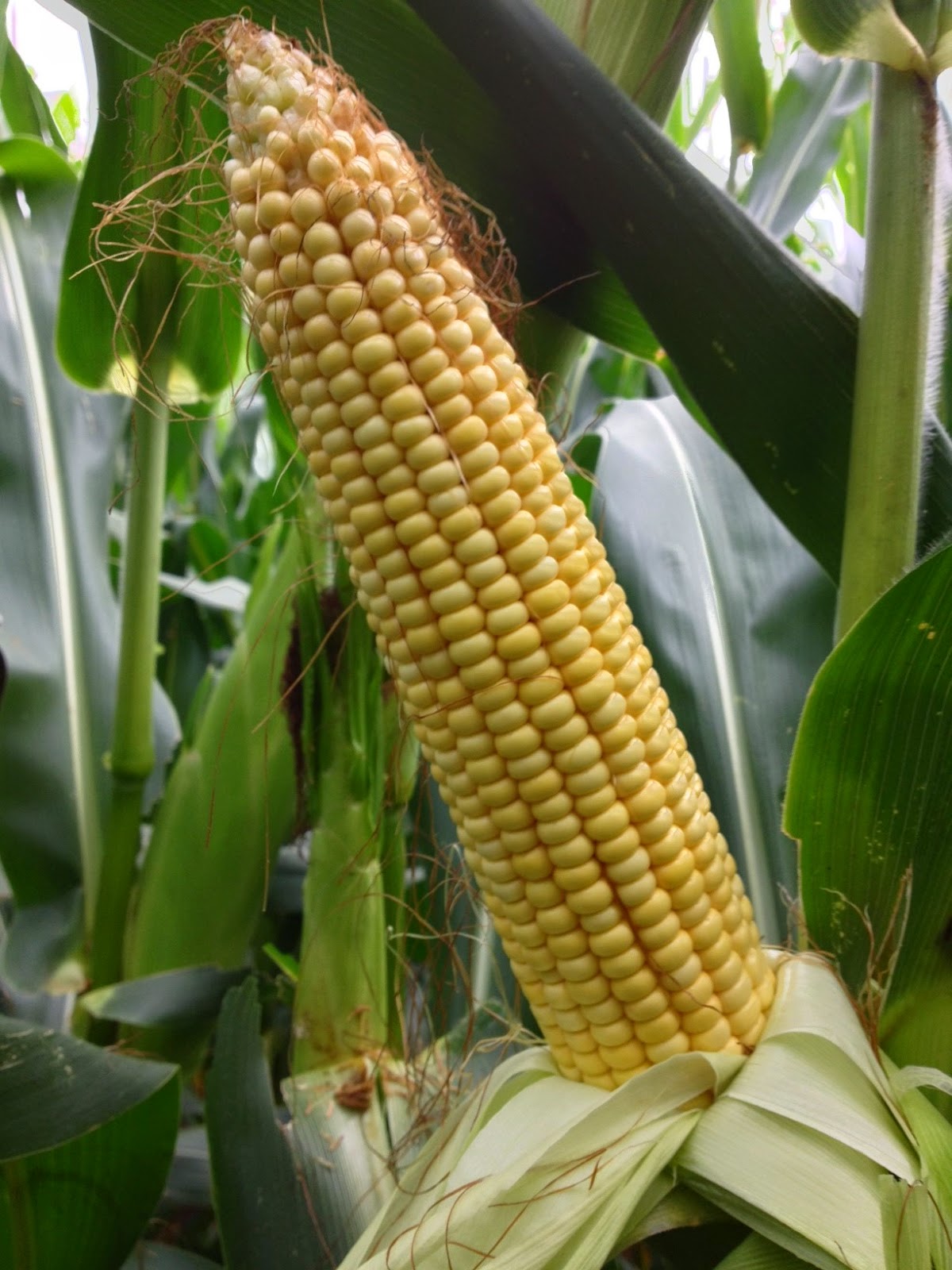
Let's consider the stage of the crop.  The 2013 crop was in the dough stage while the 2014 crop is in the milk stage of development.  How do we know?  It is not that hard.  The fact that kernels are just starting to yellow in the 2014 picture indicates the beginnings of rapid sugar accumulation in the kernel.  This is the classic "sweet corn" stage.  All sugars are very liquid and very tasty.  There is no sign of an embryo.
In the late dough stage is the kernel is still very soft and mushy, but the embryo can be found.
The embryo is in the tip of the kernel.  If you take the tip off and squeeze the kernel, the embryo will slide right out.  This is shown below.  The embryo is a hard, oval shaped structure.
The difference between the milk stage and the dough stage is about 12-14 days of development time.  
The standard average time from silking to black layer formation is about 60 days.   
Corn in early milk stage corn is about 45-48 days away from black layer,   Dough stage corn is about 34-36 days away from black layer.  This gives a more accurate answer to the question of where we are at.
My experience has taught me that September is an important month 9 years out of 10.  We needed a good September last year and we got it.  This year P0216AM will  need a good September and some of October.  This is not that unusual.  It is very worth remembering that the average killing frost date for this area is October 7. One quick witted customer observed all that means is frost can happen any where from September 7 to November 7.  He is 100% correct with that conclusion.
Earlier hybrids like P9807AM are more advanced than P0216AM.  Very normal and what we expect to see.  Does it mean much?  If a killing frost happens before the end of September, yes it will mean that the earlier hybrid likely will have the advantage. 
Seed companies are already starting to jockey and talk about how one hybrid is more advanced than another.  "Our hybrid is denting and this competitor hybrid is not", which shows how smart we are, is the standard approach used.  When I sold my corn last year I was paid for dry bushels delivered and I know that fact has not changed.  We expect corn moisture to be high this fall and earlier hybrids will be drier, as they are almost every year.  However, it is way too early to make too many predictions on hybrid performance.

Friday, August 22, 2014

The Bermuda Triangle


This simple diagram is a depiction of why diseases occur, why they are sometimes severe and why they sometimes are not.  Let me explain.
White mold in soybeans is a good example.  It can devastate a soybean crop with yield losses as high as 50%.
White mold, caused by sclerotinia spp, is a garden variety common disease pest.  It affects many different plant species including crops such as white beans, peas, canola, sunflowers and many vegetables.  I have also seen it on weeds like pigweed and lambsquarters.  In other words the pathogen is always present in big numbers because of the diverse host species. Because of this fact we can safely predict the pathogen part of the triangle is a permanent fixture.
The two environmental factors that have the biggest influence on white mold are moisture and temperature. As white mold growth matures, the white cotton moldy growth bonds together and forms sclerotia.  Sclerotia are hard black bodies, commonly referred to as "rat turds".  The sclerotia overwinter in the soil and can survive for up to 5 years when they are buried by tillage.  High soil moisture levels encourage the sclerotia to "germinate" and produce fruiting bodies shaped like small mushrooms.  The mushrooms produce spores and the cycle continues.
The temperature that favours white mold growth is 10-20 degrees C.   If you think about the temperatures that occur under a dense canopy of soybean leaves combined with lots of soil moisture, you can begin to appreciate how the disease can flourish in this "environment".
Given the fact that the pathogen and environment part of the triangle are often present, why do we not see it expressed in every soybean field?   They are all lush with dense canopies this year.  The answer to this question is found in the host part of the triangle.  In our immediate area it had become uncommon to find white mold in soybeans. In fact several times this year some intelligent growers have asked what is causing the dead plants to show up in soybean fields.  They have not seen the disease for many years and have just forgot what it looks like.  Going back 30 years to when soybeans were first becoming popular it was very common to have white mold infection in the soybean crop.  That was due to the fact that a couple of the popular soybean lines were very susceptible to white mold.  Any one remember the variety Evans?  There were not many varieties to choose from so growers were forced to take chances with susceptible varieties.  It takes a lot of work, but smart soybean breeders have been able to screen for white mold susceptibility within the genetic lines they work with.  There are many soybean varieties that are just not very susceptible to the white mold infection. Growers are quick to toss out varieties that they discover to be white mold susceptible in their fields because there are other options.  Despite this, extremely high pressure of white mold can on occasion overwhelm genetic defenses.
So the disease is predictable to a point.  We understand the disease, the environment and we know a lot about the genetic component.  We can identify fields and soil types that are more prone to infection.  We have some fungicide tools that reduce the impact of white mold, but the fungicide has to be applied at high rates, which is expensive if there is no white mold present and need to be applied at first flower.  We should be able to scout a field and identify the potential risk.  Just look for the mushroom shaped structures on the soil surface that I referred to earlier and you would know where and when to spray, the same way we do with weeds.  Not so simple.  Many pathogens in nature most of them harmless to the crop, use similar looking mushroom bodies as part of their life cycle.  Deb Campbell, a sharp eyed agronomist, has spent years trying to identify the specific white mold "mushrooms" as a service to her clients.  She admits to still not being able to positively identify the pathogen at that stage.  If Deb can't find them the rest of us don't have a ghost of a chance.
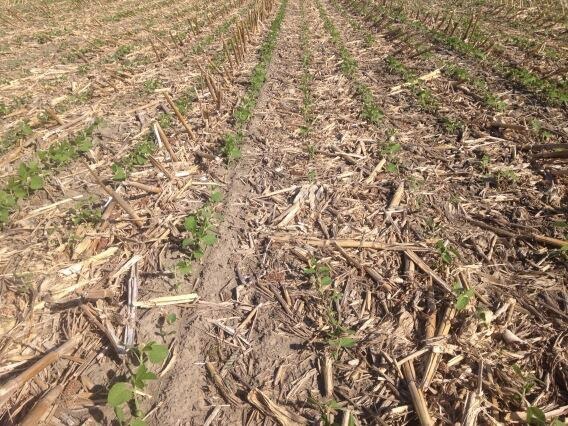
Farm management has a significant impact on white mold.  If we go back 30 years, conventional tillage was the norm for every crop.  No-till was a "radical fringe" element.  In the last 20 years no-till has become a normal farm practice.  The adoption of no-till had an impact on white mold because the turds laying on the soil surface are subject to predation by insects and mice.  And they need to be buried to germinate well. In the last 5 years, tillage has become much more fashionable again.  I believe, at least in this immediate area that the return of tillage is having a positive influence on white mold infection.
Thanks to the skill and effort of soybean breeders the disease is not as devastating as it once was.

In the corn crop leaf diseases that enjoy cool weather are now easy to identify.
The one disease that is on everyone's radar after last year is northern leaf blight.
You can find it in many fields by the cigar shaped lesions, but at the moment it is at low levels.
Common eyespot is a also present.  It is easy to identify because it looks like an eye.
This picture is not great, but I believe it is the early stages of common rust.
How much of a problem the combined effect of these leaf diseases have on the corn crop will depend on the weather in September.  It is the goal of fungicides to reduce the effect of these diseases and they do a good job in that respect.  It is well known that fungicides keep the plant alive longer by reducing the level of infection.  It is also why some of you resist fungicides because the plant is slower to die and the resulting drying bill causes heart burn.  It is important to remember fungicides they are not 100 % lethal to every fungal disease and you may still find leaf disease in a treated field.

While you are out looking, please remember that not every symptom found is disease.
 
This ugly spot is not something you do anything about.  It is pollen that was caught in the leaf collar and is now rotting.  I guess you could say the pollen is composting inside the collar and consuming some green tissue in the process.


Thursday, August 7, 2014

War & Peace

Last week nature unleashed a blitzkrieg of sorts in parts of southern Ontario.  Jeff Steiner, a Pioneer sales rep posted this shot of a soybean field near Oshawa.  Devastating to say the least.  I think hail has the greatest traumatic effect on growers of any weather event.
The yields losses due to hail damage are well documented.  Hail is among the most studied of weather events by crop physiologists because it is a very common event and easy to simulate.
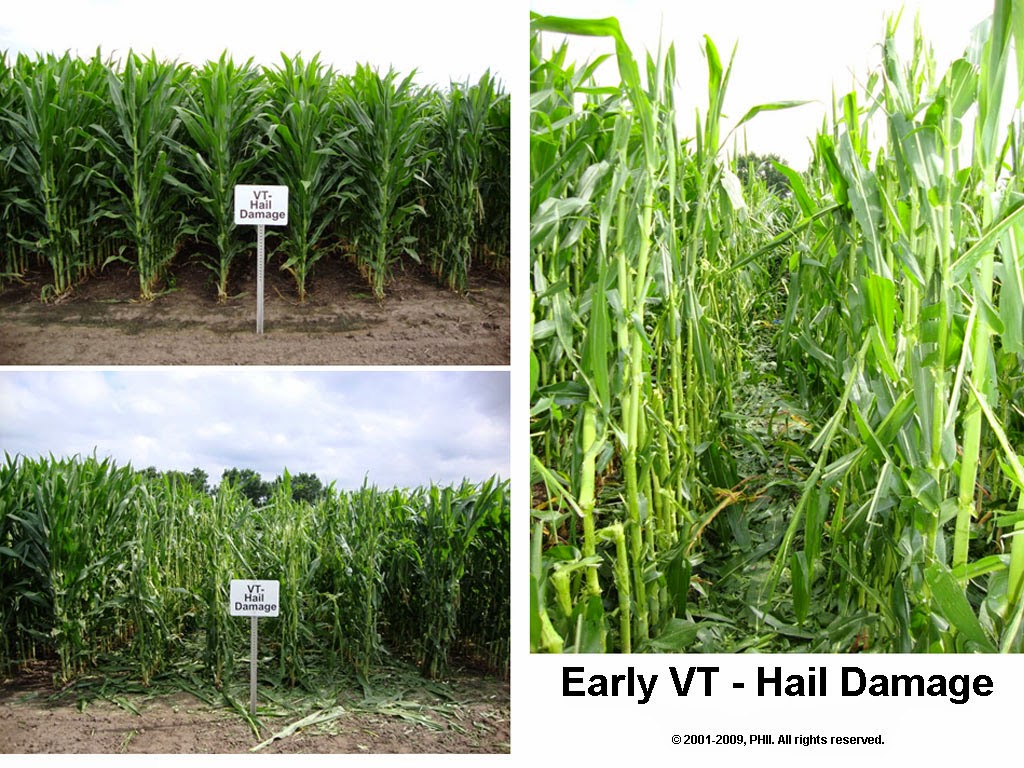
This is an example of research conducted by Pioneer studying the effect of severe hail damage.  Hail during the pollination period of corn produces the highest yield losses.  If you strip the tassels and silks off a corn plant it stands to reason that yield will be low. Fortunately this amount of severe damage is a rare occurrence in Ontario.

On the north edge of St Marys last week a couple strips of hail also fell.  Thankfully, nothing like Jeff's field.
A few shredded leaves, but tassels and silks are still in one piece.  
In fact the tassels were starting to shed pollen while I took these pictures the morning after the storm.  
A check of the leaves near the ear shoot reveal that these leaves are more or less intact.  
The ear leaf is where a large portion of yield drive comes from.  If the ear leaf is intact yield losses are small.
An adjacent soybean field looked like this.
A few broken stems and partially shredded leaves.
The problem with assessing hail damage is the fact that farmers over estimate the effects of the damage. Understandably so because it is a traumatic effect.  However, in both these corn and soybean fields yield losses will be greater from waterlogged soils thanks to the rain that accompanied the hail.  The yield loss effect from this amount of hail is in the less than 5% category.  If it was your field would you agree?

The typical question following these events involves fungicide application.  There is a feeling that fungicides will help hail damaged crops.  The research on this topic does not agree.  The benefits of fungicides are no greater on hail damaged crops than non-damaged crops. 

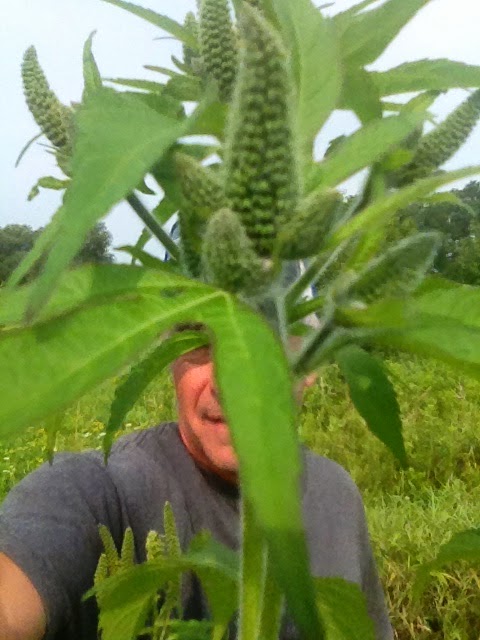
Do you know what this weed is?
I know I am short, but the stature of this weed is still impressive.  It is giant ragweed.  Is proliferates along creek and stream banks throughout the area.  Why is this important? Giant ragweed is one species of weed that can exhibit glyphosate resistance.  Some strains of giant ragweed are not killed by glyphosate.  Multiple applications of glyphosate alone will select for these plants.  It can destroy a soybean field.
There are soybeans under the the umbrella of giant ragweed. In this case it is not glyphosate resistant ragweed because the field was not sprayed with glyphosate.  But you get the idea how this weed can take over. Please remain vigilant. 

Finally, a peaceful intruder was found in Cathy's garden.
Cathy planted a row of butterfly weed and sure enough the monarch butterflies located it. How they find one row among other flowers is amazing. A new generation of monarchs are on the way.  


Monday, July 28, 2014

A Labour of Love

I have been ignoring this blog for the last few weeks, not because I have been on vacation, but because I was totally engaged in a project that had its beginnings with our home renovation project back in the summer and fall of 2012.
Guests would look out our new patio doors and inquire about our plans for the deck that they assumed would be built.  Oh no, Cathy would say, a set of steps leading down to a stone patio would be much nicer than a deck.
Last summer we investigated some options and at one point were leaning to stamped concrete.  Our daughter Melissa, cried foul and said oh no, stamped concrete is not the answer. There is a "concrete product" that would be much nicer.  As everyone knows, the two words "much nicer" are always followed by the two additional words "more expensive".  Nonetheless the special product was ordered.  A quote on installation was also received.  At that point Cathy declared oh no, that was too much money.  We can do it ourselves, love will keep us together.  Melissa concurred by telling us she had friends in the business of backyard installations who say the product is dead simple to work with.  I know the sales rep and we can also ask him, she claimed.  I think you can tell where this story is going.


There is a reason why all the home improvement shows on TV use an army to get the real work done while the know-it-all host describes how easy it is to complete the project.  The host would die of exhaustion if they actually had to do the work.  However, the hardest part is now completed and it will definitely look very nice when fully finished with appropriate flower beds and accessories.  No thanks to Melissa who was never around to actually help.  But we still love her and will take her advice anytime.

Meanwhile agronomy questions need addressing.  The most pressing question has been the topic of fungicide application to corn.  Sliding commodity prices are taking the shine off the practice.  If you questioned the economics of fungicide with $6.00 corn, current offers at less than $4.00 will make you question it more.  I have to agree because if you weigh the average response of 7-8 bushels per acre against the additional cost of $16-35 per acre there is not much room for growth in the bottom line.

Ryan Kennes, a fellow Pioneer rep has written a nice summary of his feelings on fungicide use at the following link.

http://northmiddlesexseed.blogspot.ca/

I particularly agree with his comments on Proline.  Livestock producers need to seriously look at this as a means of reducing the risk of gibberella ear mould in corn.  Our side by side work with Proline last year produced 10 bushels improvement in yield and 50% reduction in ear mould.  We are conducting a Proline trial again this year to increase the data set.

A good discussion about Northern Corn leaf Blight is also available at this link.

http://extension.entm.purdue.edu/pestcrop/2014/issue16/index.html#corn

In the meantime, if you want to help lay some flagstone or dig a water pond come on by.

Monday, July 7, 2014

2014 is Back to Normal

It is early July and the normal questions are coming in.
Why are the soybeans yellow? Why does my corn have tillers?
In these parts of south Perth county, June was much kinder than May.  Bill Arthur provides heat unit records to me, which he has been collecting for over 30 years.  His temperature data shows that 2014 is a very good example of average with respect to heat.  Heat unit accumulation to the end of June is very close to the 30 year average, which for these parts is within an eyelash of 1000 heat units.  It is easy to tell this is a typical year because corn is now anywhere from mid-thigh to shoulder and on the fast track to tassel by the end of this month.

Corn planted during the last week of May did not get the full benefit of this heat, but as I have explained before late planted corn makes up the difference by advancing quicker through the vegetative growth stages.  The later planted corn is more uniform on average than earlier planted corn which has an additional positive effect on yield for the later planted fields.  The 45 mm of rain received  in June is half the normal amount, but still more than adequate to sustain early growth.  Life is good.

Soybeans are going through a normal yellow stage of growth.  This year the condition is a little more pronounced than average, but not a significant cause for alarm.  It is a transition period before flowering really starts to commence.  The plant is experiencing rapid growth but the nitrogen fixing nodules have not kicked into high gear yet.  The yellow fades within a few days.
There has been some chatter this week about applying nitrogen to soybeans. I have witnessed before the effects of nitrogen availability on early growth.  It can be quite dramatic.  This picture is from 2010.
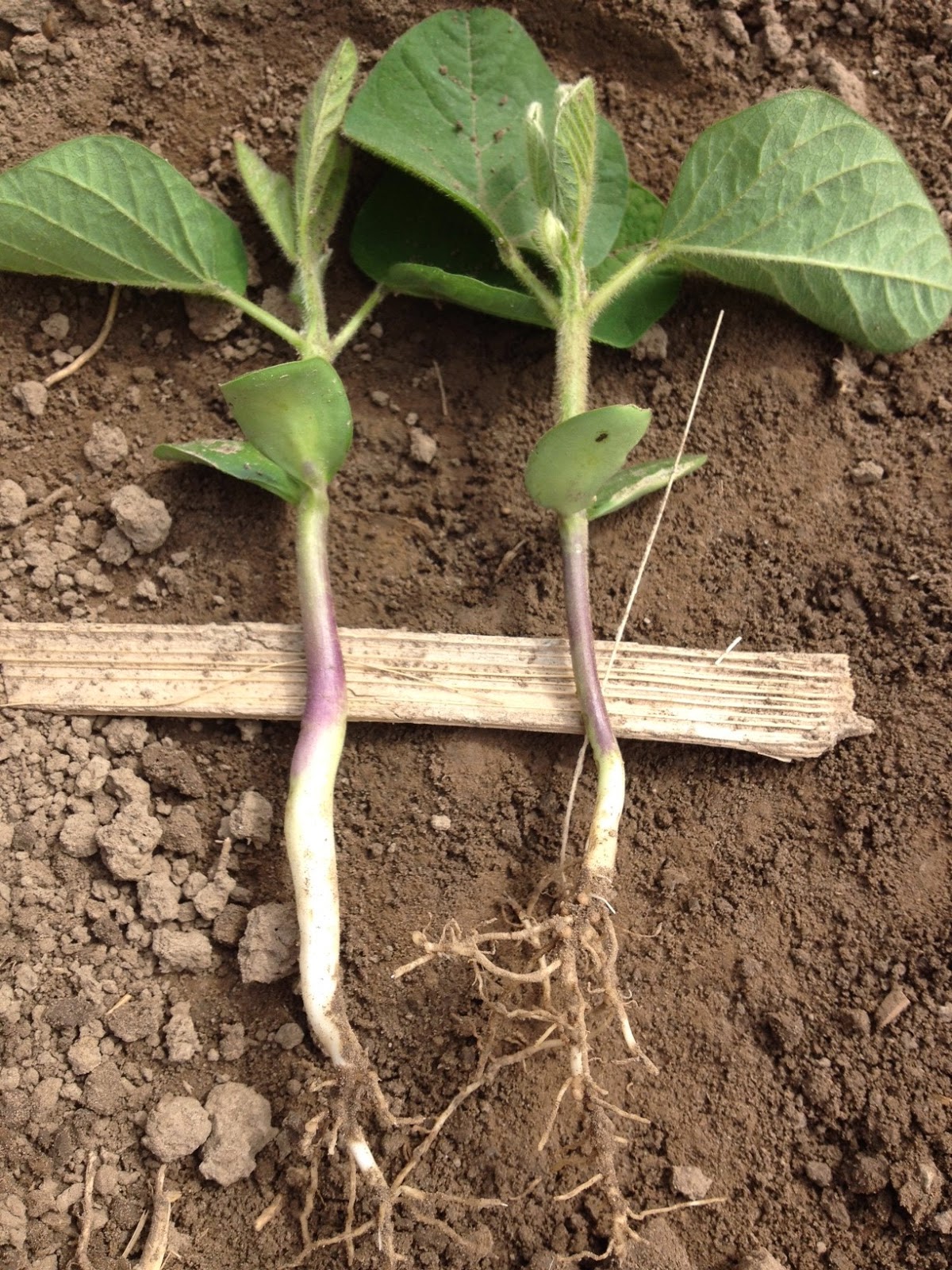
It is the same variety.  The yellow plants on the right definitely look distressed.  If this was a corn field we would jump all over the yellow corn with side dressed nitrogen to bring it out of its funk.  There are some that believe we should be applying nitrogen to soybeans at this stage.  It is not a new idea.  I played with urea on early flowering soybeans in the 80's and came away frustrated mostly because I was the guy trying to sell the urea.  The idea does have merit. It is a standard practice when nodulation failures occur on first year soybeans where there is no native population of nitrogen fixing rhizobia to infect the soybean roots. Commercial nitrogen fixes this problem very efficiently.
However, this is not what caused the yellow beans in the photo.

The field has a history of soybean production.  Nodulation was excellent as shown above.  There is a rotation difference, with wheat being the previous crop on the left and corn on the right.  It looks like the beans on the left would be at least 10% better than the beans on the right.  However, at the end of the day the yield difference was negligible.  The ugly ducklings still produced 55 bushels.
Another type of yellow was also on display last week.  A lot of IP soybeans are grown around here and they had to be resprayed for weed control.  The result was lots of scorched soybeans.
It is predominantly surfactant burn as shown by this next picture.
Again, you would think these beans have taken a big hit.  I personally hate doing this to soybeans, but the price needs to be paid.  The yield loss will be tolerable, if the IP premium is captured .  Maybe we should be putting some nitrogen on these plants to help them recover from the shock.  Just kidding.  Because I am not an IP guy I will let someone else figure that out.
The true challenge of trying to manipulate the soybean plant at this time of year is recovering the dollars spent.  Weed control dollars are always a wise choice. Fungicides?  Yes, 2-3 bushels is the expected response and that more than covers expenses.  Supplemental N?  Not a clear cut answer.  We need 2-3 bushels to pay for the added expense.  My experience trying to boost soybeans with fertilizer in early July has produced more failure than success.  I am still open to suggestions.

Corn tillers are also prevalent this time of year.  Perfectly normal and usually not a reason for concern.
You will rarely see tillers on a poor field of corn.  Corn is a grass, and as such tiller buds are present at the crown.  If moisture and fertility are abundant, sunshine hitting the crown will stimulate the tiller buds to grow. This is why tillers are often more prevalent on the edge of the field beside a mowed laneway.  Lots of sun on the outside rows will encourage more tillers.  They can also be found 30 rows into the field like the plant in the picture above.  Tillers are luxury consumers and do not stress the main plant. If the main plant is stressed the tillers will stop growing.  During grain fill, the main plant will consume the reserves accumulated in the tiller to help the grain fill process.
The presence of tillers can indicate you could have possibly bumped your plant population by another 2-3000 per acre because the plants are telling you they are not stressed at all. Genetics sometimes come into play because a hybrid can be predisposed to producing more tillers than average, but this is rare.  
 

Sunday, June 22, 2014

Better Crops? Not!

This is embarrassing.  I am supposed to know better.  I have a bean field that is a bit of a mess.  And I have to look at it every day because it is beside the warehouse.
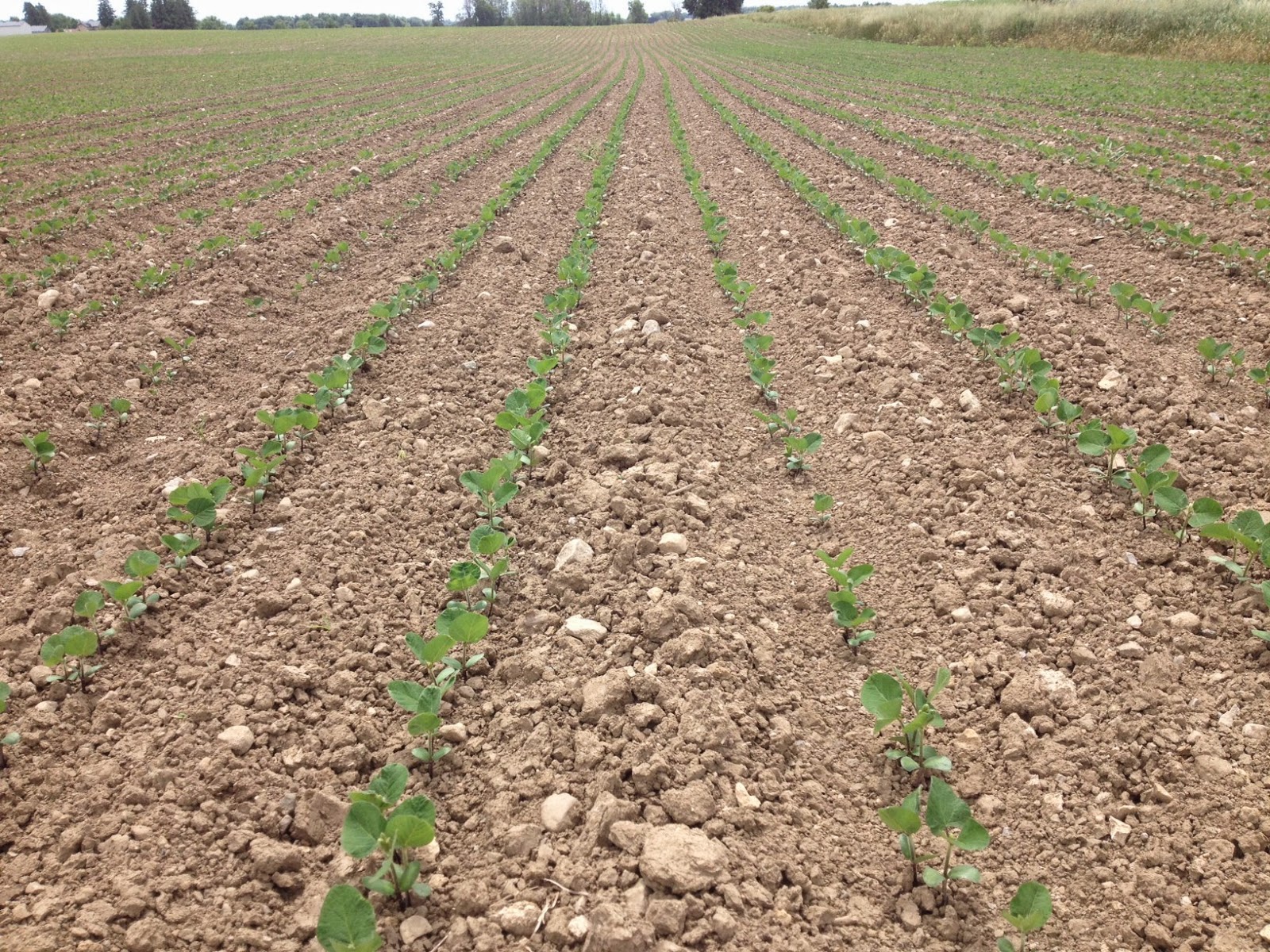
The recipe started out alright.  Harvested corn last fall without causing any ruts, although serious compaction was left where the buggy tracked in and out.  Did no fall tillage because soil was too wet.  Two trips with an RTS on May 18th to incorporate and distribute some of the heavy trash.  Rain later that week kept us from planting.  Planted on May 29. Checked seed depth and adjusted to 1-1.5 inches thinking I had adequate moisture at that level.  At 2 inches I figured I had gumbo and did not want to go there. That was mistake #1.  A combination of 200 bu corn residue from last fall and rapidly drying soil conditions caused me to misjudge the moisture line as the day progressed.  Count this as mistake # 2.  The resulting variable emergence is a direct result of these two decisions. All because I did not check seed depth and moisture conditions often enough. Attention to detail is a characteristic that separates smart folks from the not so smart.  On that particular day count me as one of the not so smart.

Misery seems to enjoy company.  My buddy Paul Sullivan from the Ottawa Valley tweeted a picture of soybean emergence amid heavy corn stalks.  It looks a lot like my field.
A survey of other soybean fields in the neighbourhood revealed some similar lack of attention to detail.  The owners' identities are being withheld.

Yep, those are beans on top of the ground.  And some are still germinating after .5 in of rain last Wednesday.
None of these fields are candidates for replanting, but when the goal is to produce high yielding crops, uniform emergence is a very good starting point.
This field is enlightening.  Fall plowing on the left and no- till on the right.  Excellent emergence on the left, less than excellent on the right.  
Planting depth of beans on the left averaged 2".  Those on the right averaged 1" or less.  It is not complicated.  The deeper planted beans in the conventional tillage were put consistently into moisture.  The no-till beans were planted shallower and did not consistently find moisture.
Many farmers have an inherent fear of planting too deep.  Usually based on one or two experiences with deep planted crops that did not emerge.  There is far less fear of planting shallow.  My years of experience have taught me that problems created from planting too shallow out number the problems created from planting too deep by at least 5 to 1.  And I still planted too shallow.  That is the definition of dumb.
The best beans this spring are those planted into conventionally tilled ground.  It seems that at this point there was no such thing as too much tillage.


But the secret is not tillage.  It is placing seed uniformly well into the moisture line.  Even when that line is two inches.
Coming back to my field by the warehouse.  The story is far from over.  The worst spots are close to the road.  The majority of the field is very acceptable.  As Horst Bohner says, the month of August makes beans.  Differences in June do not always mean much in the soil types of Perth county.  That is the unique thing about soybeans.  They do not punish us for our spring mistakes like other crops do.  Part of the reason why bean acres outnumber corn acres.