Monday, January 31, 2011

When What We Believe To Be True????

If you ask 100 agronomists about early spring soil temperature vs soil depth, I would guess 99 of them would say that the closer you get to the soil surface, the warmer the soil temperature.  If you ask 100 farmers the same question, I would guess 90 of them would agree because I tend to think farmers are smarter than agronomists.  Regardless, there would be general agreement that in April, soil will be colder at 2-3" than it is at 1" or 1/2". 
My own random use of a soil temperature probe in April has made me wonder whether this was really true, but I am a believer that corn should be planted at 2" deep, (more on that later) so I did not care what the temperature was like at 1".
As food for thought, along comes a study presented in the Pioneer Agronomy Journal discussing soil temperatures vs soil depth during the months of April and May.


Fascinating stuff.  During the month of April the soil temperature was the same at 2" as it was at the shallower .4".  Could it be that what we believe to be true is false?  The relationship was the same no matter whether the soil was tilled or not.  Tilled soil was slightly warmer than no-tilled which makes sense, but in April the depth made no difference.  It was not until May when the air temperature warmed to 25-28C that the shallow soil began to warm faster.  Why would the soil not be warmer at .4" in April?
Two reasons.  Sunlight intensity and air temperatures are lower in April.  The second reason is the deeper soil acts as "insulation".  In April the soil is usually drying slowly and moisture is migrating up from lower depths.  This water is still cold and it keeps the shallow soil from warming as quickly as we think it should.

Now the practical stuff.  What impact does this have on planting depth decisions when we plant in April?  As I said before I am a firm believer in planting at 2" deep regardless of conditions.  The only time I would go deeper would be in extremely dry seedbeds, but I would never go shallower.  Here's why.


All crop advisers recommend a planting depth for corn at 1.5 to 2 inches for two reasons.  It is easier to maintain good seed to soil contact to allow uniform moisture uptake by all kernels.  The second reason is to support a strong nodal root system which develops at 3/4 of an inch.  The nodal roots develop into the main root structure that absorbs water and nutrients for the entire growing season.  A strong nodal root system is obviously impacted by planting depth.


This clearly shows the nodal roots getting off to a good start.  Note how they start to grow at about 3/4 inch below the soil surface.


The seed on the right which was planted at 1" is going to struggle with nodal root development and will be slow to grow.  As farmers we make more mistakes planting crops too shallow than we do planting them too deep. 
Considering soil temperatures do not support shallow planting in April, we have no excuse not to get our seed into the 2" zone.


Wednesday, January 26, 2011

Re-Cycled Ideas

A friend and customer asked me a question last week beginning with the preposition "I was looking on the internet".  I had to resist rolling my eyes because that phrase usually leads to a dumb question.  But he continued and asked me what I thought about twin row corn.  This is a concept that has been around my whole career and it seems to re-surface every few years.
The concept is simple enough.  Just modify your standard 30" corn planter to plant two rows instead of one row as shown in the picture below.


The theory behind this is to give each plant more room to capture sunlight because they are not as crowded as they would be if they are all crammed together in one row.  This is to have a more positive yield effect as we increase plant populations. 
(Excuse me for a second while I digress.  I believe this is why the concept keeps getting re-cycled.  When I began my career 28,000 population was considered high, now we are talking 36,000 plants per acre.  At every incremental step over the years, somebody tries to prove the value of twin rows.)

At a plant population of 36,000 the space between plants is 5.8 inches as shown in the schematic diagram below.


Using twin rows 8" apart centered on 30", the interplant spacing for 36,000 poulation is 9.9" to 11.6".  This is almost double the room for each plant in the the twin over the single row.  Common sense tells us this should result in healthier plants and more yield. 


But I know that common sense and corn plants do not always agree, so what does the research tell us? 
Both Pioneer and John Deere looked at this concept in 2010.  They co-operated together on some of the trial locations.  Pioneer likes to sell seed and John Deere likes to sell equipment, so it is reasonable to conclude they would be interested in the concept and it is also reasonable to conclude they would both be interested in a positive research outcome. 
Both companies came to the same conclusion.
In 31 locations across the corn belt in 2010, Pioneer found the overall advantage to 8" twin rows over 30" rows to be negative .7 bu/acre. 
John Deere reviewed the scientific literature on twin rows from 1980 to 2008 and discovered a .7 bu advantage in favour of twin rows.  Hardly a rosy picture for those that believe in the twin row concept.
And as my friend, Peter Johnson, said at the Southwest Ag Conference, "combining twin rows at night, with all those tassles jiggling in front of the cab will make you want to quit farming".
So my friend was not asking a dumb question after all.  It was just a question that has been asked many times before. 


Friday, January 21, 2011

Back to Work

I have been negligent in keeping up with this blog for the past 4 months, but 2011 will be different, I promise. 

January is meeting month in the crop service industry.  Every week there are multiple days devoted to spreading the latest word on crop and business management.
There was the Southwest Ag Conference, the CCA Annual Conference and the Pioneer Agronomy Conference, plus a couple of other Pioneer events.  I learned some new things from all these meetings and have a boatload of knowledge to pass along.

But more importantly this past month has been a memorable month for two other reasons.


I was shocked on January 12 to receive the CCA Award of Excellence for 2010.  It is indeed an honour to be recognized by your peers for your contribution to agriculture.  I must thank my nominator, Pat Lynch for pushing my name forward.  It means I have a responsibility to strive to make myself better and help my customers even more in 2011. 
I also want to recognize the other nominees for the award.
Shannon Bieman from Snobelein Farms, Larry Hale from FS Partners and Bob Thirwell from Dekalb.  These three had very impressive credentials and deserved to win as well.  Just to be included with them is honour enough, to win is unbelievable.

On January 16 a much bigger award was presented.  Brian and his wife April made Cathy and I grandparents for the first time. 


Hayden Brian Barker arrived at 7:50 am on Sunday, January 16. 

This beats the CCA award hands down.

Monday, September 20, 2010

Pre-Season Fantasy Pool Picks

With corn harvest around the corner, as well as the NHL season, it is time for the corn hybrid pool picks and predictions.

Get ready for some big corn yields.  Last year we had a cooler than average year.  This year, warmer than average by approximately 300 heat units and very little stress.  This gives full season, offensively minded high yielding hybrids a big advantage. 
Early soybean yields have confirmed my earlier thoughts.  I told our agronomist, Morris Sagriff a month ago that I have seen soybeans like this only once before.  That was in central Illinois! 
There have been a couple of confirmed reports of 70+ bushel soybeans, lots of 50-60 bu reports.  I know one client that grew 50 bu natto beans. Tacking on the $4.00 premium makes potentially $700 per acre.  WOW!  Probably wise to keep some of that cash in reserve for next year.

Now for some hybrid specific predictions.


Reliable stay at home defenseman who can also quarterback the power play.   Will never win a scoring title, but this veteran can make poor coaches look good.


This hybrid is our power forward pick.  Big and rangy with great offensive skill.  Good roots and stalks make up the defensive package.


New league scoring champion for 2010.  Move aside, Sidney Crosby.  This new hybrid also brings some defensive drought tolerance. 


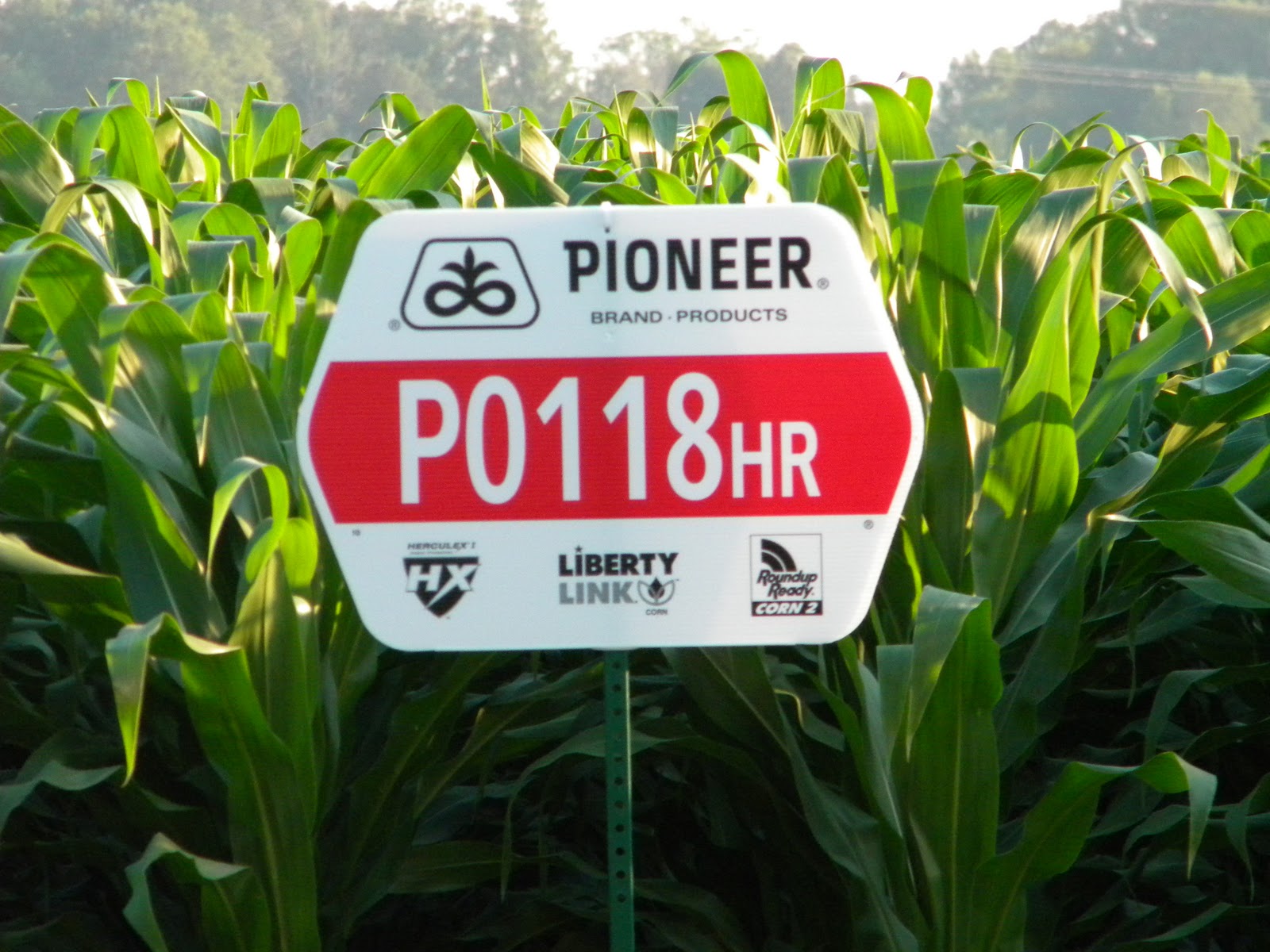
Second line centre.  Will provide secondary scoring punch to P0118HR and replace 37Y14 family in the lineup.


Raw talent gives this rookie a chance to make lineup as defensive partner to 38M58.  Showed real promise in 2009's shorter season.


Thursday, September 2, 2010

Do We Have to Feed the Whole World?

It is now real easy to find things that enjoy chewing on our corn crop.  Curtis Gartly sent me the pictures below of damage caused by the Western Bean Cutworm.  These picturers are from a plot of DeKalb DKC50-44.  This is an example of a hybrid that has the YieldGard gene for corn borer control.  The YieldGard trait provides excellent protection from corn borer, but will not stop western bean cutworm feeding.  The Herculex gene is the only gene that gives protection from both corn borer and western bean cutworm.


Typically western bean cutworm larvae burrow into the ear and feast on the developing grain.  Pioneer has a complete lineup of Herculex trait hybrids that provide the extra insurance against the western bean cutworm.

Western bean cutworms are not the only fox in the henhouse this year.  The next set of pictures were taken from a field of Pioneer 36V51.  36V51 is an example of a hybrid with the RoundUp Ready gene, but no gene for corn borer control.  Surprise, surprise, there is corn borer in this field.


The purple stalks are a classic symptom of corn borer injury.  The corn borer that you see burrowing into the stalk cuts off the flow of carbohydrates produced by the upper leaves.  The carbohydrate buildup in those leaves triggers the plant to produce a purple pigment called anthocyanin.   
You can trigger the entire corn plant to turn purple if you remove the ear.  By taking the ear away we remove the sink for the carbohydrates produced from the leaves and stalks.  Within a few days the whole plant takes on a purple hue.   
There is one good thing to say about corn borer.  They eat western bean cutworms.  36V51 has no protection against western bean cutworm, but as long as corn borer are present, no western bean cutworm will survive.

Monday, August 30, 2010

"Beans, Beans" Chapter 4

We have been following the plight of a soybean field planted mid-April and first reported on May 6.  This is what it looked like back then.


Then it froze on Mother's Day and the betting began.  Will they survive?  A week later they looked like this.


Two weeks later they looked like this.


One month later they looked like this.


Today, they look like this.


And this.


The final chapter will be written in 2-3 weeks.  Stay tuned.

Right On Schedule


On Saturday August 28, Lawrence Vink was chopping 37K84 for Hilant Farms at St Pauls.  This field was planted the last week in April and pollinated mid-July.  
Most bunker silos in our area will be filled this week and tower silos will follow right away.
Two weeks ago we talked about corn hybrid maturity and the 5 stages of 12 days from pollination to physiological  maturity.  As a quick review the 5 stages are

1. Milky embryo or blister stage
2. Young sweet corn stage
3. Beginning dent stage
4. Half milk line stage - 65% whole plant moisture
5. Hard dent stage - 35% grain moisture


We explained before how corn maturity advances like clock work once pollination is complete.  45 days after pollination, this 37K84 is at 65-68% whole plant moisture.  Hilant had Lawrence cut this corn high to maximize energy content in their silage.  The part of the field that did not fit into their bunkers will be ready to harvest as cob meal in two weeks.