Monday, June 24, 2013

"Lots of Worm Holes"

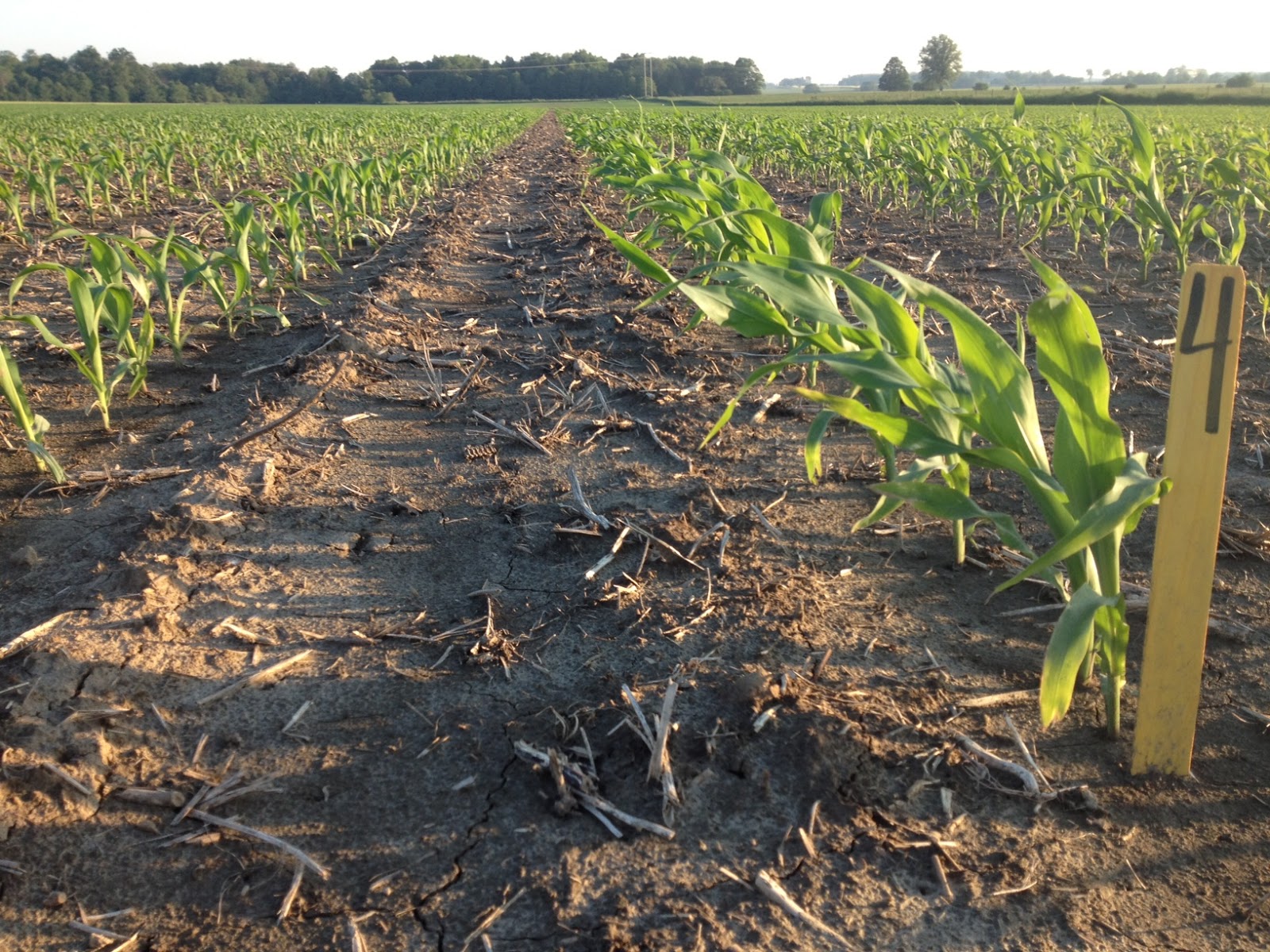
"Where the corn is good, I see lots of worm holes."   These were Brian's words last week after 5 days of constant spraying activity.  We were comparing notes on what was working and not working in customer fields.  This is an example of what he was describing, a nice uniform consistent stand of corn.
A close up picture shows part of the reason why.
These are piles of soybean trash that big dew worms have pulled together over their burrows.  These piles of trash are called middens.  Under each midden is a hole the size of a pencil.
These holes allow air, water and nutrients to move up and down in the soil profile. Aeration is critical for good plant growth.  It is no coincidence that the presence of worms is an indicator of good soil health and crop growth.
Worms will have a very tough time in the type of environment below.


There is no way that worms, or roots, can penetrate soils like this one.  You end up with corn that looks like this.
In this particular case we all know that compaction from heavy equipment is the reason. The corn on the right edge of the picture is against the fence line and does not get the wheel traffic.  Less wheel traffic means less compaction means better crops. But it is not always easy to identify the reasons for purple or yellow stressed corn.  
This one is not as obvious, but the causes are related to past soil management practices.
I believe you always have to think of air.  Or more precisely a lack of air. If we could pump some air into the stressed spots they would change for the better literally over night. Which brings me back to my worm friends.
The question is do worms promote soil health or does good soil health promote worms? It is a classic chicken vs egg discussion and in most ways irrelevant.  One goes with the other.
My top 4 methods to promote soil and worm health are these.
1.Drainage.  Most refuse because the upfront cost is high, but if you own the land the best return on a dollar spent is systematic drainage.  Forget the old drains your grandfather put in.  Plow in a complete set of new ones.  Equipment gets bigger and heavier and the risk of damage increases exponentially with every new combine, grain buggy and manure tanker.  Without excellent drainage, dollars spent on all other crop inputs are wasted. Drains pay their way in dry years and wet years.  If you consider drains as a crop input, there is no other input that can make the same claim.
2.Manage surface residue.  Peter Johnson and Greg Stewart bang away on this for erosion control.  I want to add worm health to the list.  The big dew worms that do the heavy lifting with respect to aeration are surface feeders.  Without surface trash to feed on they starve.
3.Patience. Cathy will tell you I do not possess this ability and she is right.  I admire farmers on the heavier soil types who have the fortitude to wait for their soils to dry while all their neighbours are going full blast.  
4.Rotation. No need to say any more.

Now that the good corn is growing quickly in the heat it might look like this.
Don't be fooled by the stripes.  It is not nutrient deficiency.  It is a symptom of rapid growth.  The plant is happy and you should be too.


Monday, June 17, 2013

Lots To Talk About

Crop Heat Unit Accumulation from May 3 to June 16.
(I used May 3 as a starting date because that is when the first corn was planted this spring.)

YEAR              TOTAL           NORMAL      DEVIATION FROM NORM
2013                  747                     780                            -33
2012                  821                     780                           +41
2011                  788                     780                           + 8      

Trending a little cooler than normal, but not a big problem.  I want to hear no more talk about 1992 and the year of no summer.  It is not even close.

This picture taken from my IMPACT plot on Saturday is illustrating why some fields may look stronger than others.  These are two hybrids of same maturity, planted May 6.  The one on the right is one full leaf ahead of the hybrid on the left.  WOW!! FANTASTIC!!  POST THIS PICTURE ON TWITTER!!!  CUSTOMERS NEED TO KNOW ABOUT THIS!!!  Whoa pardner, pull back on that throttle a bit.  My experience has taught me that while early growth maybe exciting to look at, it doesn't put bushels in the bin.  A June beauty queen often becomes a wicked witch in November.

One more thing we observe in corn this time of year is a buggy whip shape.  A period of fast cell division will cause the new leaves to roll tightly together and mimic a herbicide interaction.  It will recover quickly and the new leaves might be yellow because they did not get exposed to the sun.  A temporary condition that has no effect on yield.
It is also purple corn season.  Purple indicates sugar accumulation in the plant which triggers the anthocyanin pigment.  At this stage the purple colour is telling us that the roots are not growing.
This broken leaf illustrates the same condition.  The tissue is still attached which allows the chlorophyll to continue working, but the sugars are not being transported back to the plant.  The result is a purple leaf tip.

And alfalfa weevil are still around.  Check your regrowth.
This picture was taken today from a field that was cut on June 1.  The regrowth is being consumed by weevil like the one shown below.
I visited 4 fields today and they were all the same.  Get the Matador and take out the weevil.

Monday, June 10, 2013

June Pictures


John Deere corn, in need of sunshine.

Sun scald on a corn leaf.  It is a common occurrence after cold temperatures.  The sensitive tissue turns grey when it is exposed to daylight.

This one is courtesy of Dean Shantz.  Dew worms pulling corn leaves down their burrow for lunch.  No worry because the corn plant will grow faster than the worm can eat.

Frost injury to wheat.
More frost injury.
This twist is due to genetics, not frost.
Prostrate knotweed enjoys damp weather.
As does tufted vetch.  An annoying pain that never goes away.
Canada thistle.


Monday, June 3, 2013

Just A Minute Frank, There's One More Job To Do

Two farming buddies of mine, Frank and Joe are soon embarking on separate trips with their wives to the British Isles.  Considering these two lads are of Dutch heritage I find it strange that they would choose the home of the blarney stone, haggis and steak and kidney pie as a holiday destination. 

In the meantime there is one job that demands attention before Frank leaves.  Joe has already shipped off and left the job unfinished.
The wheat crop is coming into head and this will be the week to apply fungicide for Fusarium head blight and late season leaf disease control.  Timing is important for head blight, less so for leaf disease.  This picture was taken on Friday.  When 75% of heads are emerged from the boot it is considered to be day zero, which for this field will be Sunday or Monday.  Optimum timing for head blight control is plus day 3-4 meaning this crop should be sprayed between Tuesday and Thursday this week.  The majority of the wheat crop in our area will be in head by the end of the week.  Sprayer operators need to be especially careful with tank and boom clean out since herbicide contaminated solutions are the kiss of death to a wheat head.  All other spray jobs will have to wait until machinery has completed the fungicide applications.
Predicting disease levels is always a crap shoot because our environment can change rapidly in Southern Ontario.  But if there is a year when the wheat may be more vulnerable to blight it could be this year.  Fusarium development is favoured by moisture and moderate temperatures between 15-25 degrees.  So far moisture has been in abundant supply.  It is cold this morning as I write this post, but the forecast is for moderate temps later this week.
Dave Hooker posted this photo of decaying corn stalks loaded with the fruiting bodies of Fusarium head blight.  Lots of disease pressure, a susceptible host and favorable environment is a potential perfect storm.
Showers are also in the forecast for the week and the question of rain fast period for your fungicide of choice is often raised.  Fortunately the rain fast period for fungicides is short.  As long as the head is dry, 5-10 minutes is more than enough time for the chemical to dry and stick to the head.  
I love the colour in our wheat this past week.  It has a rich dark green, almost blue appearance. 
It would be a shame to lose this yield potential to late season diseases.  Frank, before you leave on the quest for some Jameson's or Bushmill's, please spray your wheat!!

Sunday, May 26, 2013

Who Wants A Cold One?


Borrowing a phrase from the advertising campaign of a favourite beverage is a cheap stunt on my part, but it seemed to fit.  Adam Van Dinther posted this frosty picture of his windshield on Saturday morning.  More on the frost later in this post because there are more important things to talk about first.

The alfalfa crop takes centre stage this week.  I was out yesterday with my PEAQ stick evaluating feed quality.  A PEAQ stick is a measuring tool that takes the Predictive Equation for Alfalfa Quality developed by the University of Wisconsin right out to the field.
For my dairy farming friends like Adam, who want their first cut haylage to be 20% protein, 30% ADF and 40% NDF, this is the week when it will happen.  


Right now alfalfa is in the late vegetative to early bud stage of development.   By randomly picking out the most mature stems and holding them up to the PEAQ stick you get an estimate of the ADF level.

This first year field was still in the vegetative state and the PEAQ estimate was 28 ADF.

In this 3rd year field that was just entering the bud stage, the PEAQ estimate was 29 ADF.  No in field tool is perfect when it comes to measuring feed quality but the PEAQ stick provides a quick and simple way of confirming that the crop is close to the magic 20-30-40 figure for high producing dairy cows.

A second reason for checking alfalfa is because reports are filtering in about alfalfa weevils.  Adult weevils overwinter in the trash and leaf litter on the field.  Before they die the females lay eggs in the stem of the alfalfa plant.  Young weevils hatch and start chewing on the leaves as shown in this picture I took yesterday.
The larvae are light green or yellow with a white stripe and black head.  When fully grown they are only 5/16" long.
They will feed for 3 to 4 weeks and then pupate.  The adult does not cause trouble and there is usually only one generation per year.
Action is required if 40% of the leaves have injury or if you can find 2-3 active weevil per stem.  While it was easy to find feeding injury in all fields I walked through, the damage I witnessed yesterday was no where close to the action level.  Generally the best recommendation is to cut the crop.  Alfalfa fields that are being left until June will need to be scouted for the next two weeks to make sure the weevil numbers stay low.

Turning back to the cash crops, corn and soybean producers will be sick to their stomach this week.  A lot of emerged corn is going to look very rough for a few days.  Two frosty nights in a row lays a major beating on leaf tissue.  My standard recommendation is to go fishing for a week.  It may take that long for the field to look better.
This corn plant will not die.  It's growing point is well protected below the soil surface and new leaves will emerge.  The leaves that have been lost to the frost will have no negative effect on yield potential.  The worst thing to do is go look at it every day and worry. Depending on the temperature, it might be Wednesday or Thursday before you will see much recovery.  Do not spray any post emergent herbicides, especially hormone based herbicides for a few days because there is no point in adding more stress.
Very few soybeans have emerged yet, so they are fine.  If they are emerged the growing point is still protected by the cotyledons and no damage will occur.
Wheat heads are still protected in the stem, so no concern there either.
Unprotected strawberries in your garden will not be so lucky.
Regardless, the very best thing to do is sit back and reach for a cold one.  Or on second thought maybe a hot one would be better.


Monday, May 20, 2013

Comeback Of The Year Award

A week ago I was prattling on in this forum about spraying wheat and planting soybeans. Seven days later, the wheat has been sprayed and most of the soybean crop has been planted.  It is 26 degrees and sunny out.  Some rain is in the forecast.  Corn is emerging in less than two weeks after planting.  It takes 150-180 heat units to get corn and soybeans emerged, so you don't need a heat unit chart to tell you how much heat we have received.   The 2013 planting season has been a huge success so far.

Brian gave me some observations from the sprayer seat after driving through approx 2000 acres of wheat.  Going over a bunch of acres provides real insight.

1. Either the wheat is really good or not very good.  Not much in between.  As always, it looks much better from the road than it does close up.
2. When nitrogen did not go on until the first week of May there has not been enough rain to activate the N.  If the nitrogen source was urea, the situation is worse and the wheat is starving for N.
3. If nitrogen and sulphur were applied together in April, the wheat looks fantastic.
4. Disease pressure is low, but where the canopy is lush the fungicide will still pay for itself.

I have stated it before in this blog and I will continue to keep stating it.  There is only one good way to control perennial weeds and winter annuals in the wheat crop.  Spray in the FALL.  Mike Cowbrough and Peter Johnson have been banging away on this one as well and the message is not getting through.

Look at the next two pictures.
Taken May 2, 2013.
Taken May 16, 2013.
Same spot, same field.  I just do not understand why this is considered acceptable. One shot of glyphosate in the fall takes care of this.  Just do it.

The comeback of the year award has to go to our apple trees.  They are loaded with blossoms.  We have never seen them like this before.
It appears the tree is trying to make up for last year's crop failure.  If all these blooms become apples the tree will collapse under its own weight.  My mouth waters with the thoughts of harvest.


Sunday, May 12, 2013

Mother's Day Style

Snow on Mother's Day isn't so bad.  It gives everyone a chance to spend quality time with their mothers. Cathy believes it was 1985 when we had 6 inches of snow on Mother's Day.  She was expecting Brian at the time.
Melissa presented a unique gift to her mother yesterday.  I suppose one could call it a fruit cake.  Except it is not the kind of fruit cake that my grandma would make.  This healthy eating thing has gone a little too far for me.
The moisture over the weekend has been a blessing for both mothers and farmers. Especially those farmers that were commenting about dry seedbeds in their corn fields. Dry seed beds last week were the result of working ground too deep and too early.  The too deep is easy to correct if your leave your field level coming out of the fall and run the cultivator just deep enough to crumble the top 2 inches.  The too early is a different matter.  I understand the peer pressure associated with growing crops and it is practically impossible to stay out of the field when everyone else is going.
Meanwhile, our attention is turning to planting soybeans and spraying wheat.  Both jobs need to wait until the freezing night temperatures pass.  We are in the prime planting window for high soybean yields and the forecast looks favourable for later in the week. Waiting a few days now for soil temperatures to rebound is a smart play in my opinion.
In the wheat crop weeds have emerged and both septoria leaf blotch and powdery mildew are present in the canopy.  But, there is too much risk of crop injury when it is this cold. Monday night's forecast is a frosty one so waiting until Wednesday to start spraying would be another smart play.
And speaking of smart plays I plan to watch a hockey game tonight.  "Go Leafs Go".